Table of Contents

Rosy Web Application
(Release version 1.1.2)
User Manual
(Admin Portal)
1. Introduction
Welcome to the User Manual for ROSY – Axess Law's Proprietary Conveyancing System. Developed with the vision of redefining real estate legal services in Canada, ROSY combines innovation, security, and simplicity to streamline the conveyancing process for legal professionals. Designed exclusively for Axess Law's internal teams and partners, this web-based application offers a secure virtual environment to manage real estate transactions efficiently. Whether preparing documents, tracking deal progress, or managing client information, ROSY provides a seamless and intuitive experience that reflects Axess Law's commitment to accessibility, transparency, and cutting-edge legal solutions.
2. General Information
ROSY is a secure, web-based application specifically developed to support and enhance the conveyancing processes used by Axess Law. The platform allows legal professionals to manage real estate transactions efficiently, from initial client intake to final closing. ROSY supports multiple user roles with varying access levels, ensuring that sensitive information remains protected while allowing seamless collaboration. The system is designed to operate across modern browsers and devices, requiring only a stable internet connection for access. All data entered into ROSY is stored securely, with regular backups and compliance with industry-standard data protection protocols. This manual provides a comprehensive overview of the application’s capabilities and how to use them effectively.
2.1 System Overview
The web application has the following functionalities:
- File Management Process
- Automated Email Templates
- Communication Channels
- Document Control
- Transaction Deal Stage Queues and Tasks
- Dynamic Roles and Permissions
- Typeforms, Triggers, and Questions
- Syngrafii Integration
- Transaction Closing Date Calendar
- Dashboard Development
- Title Search Integration
- Treefort Integration
- API Exposure and Integration
3. Getting Started
3.1 Language Option
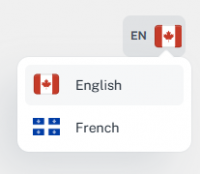
ROSY supports multiple language options to accommodate users with diverse language preferences. Users can easily switch between available languages for a more personalized experience.
3.2 Sign In
The application features a secure login option to ensure authorized access to user accounts. Users must enter their credentials to access the system and work within the platform.

3.2.1 Valid Information
First, enter your valid username and valid password, and then click the login button.
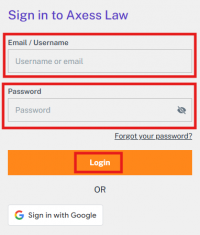
Your application will be successfully logged in.
3.2.2 Invalid Information
If your username or password is incorrect, the system will notify you with a message saying 'Invalid username or password'.
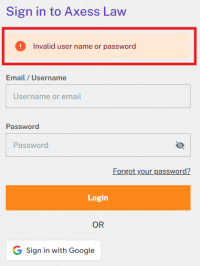
Enter the correct username and password and try logging in again. If the credentials are accurate, you will be logged in successfully; otherwise, the same error will be displayed again.
3.2.3 Reset Forgotten Password
The system provides a 'Forgot Password' option if you do not remember your password. You can click on it to recover your password.
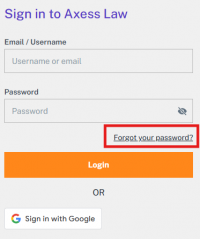
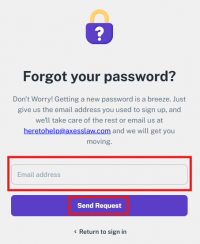
After clicking on 'Forgot Password', a screen will appear where you can enter your email address and click on 'Send Request' to submit a password reset request.
When you enter your email and send the request, you will see a screen displaying the message: “Verification Email Sent.”
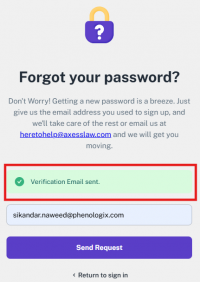
Then you need to check your email. You should have received an email containing a confirmation link—click on that link to proceed.

After clicking on the link, you will be directed to a screen where you can set your new password and then submit it.
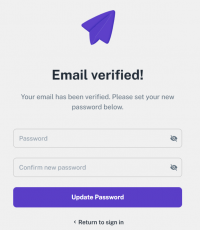
On this screen, you need to enter your new password and then re-enter the same password for confirmation. After that, click on “Update Password” to successfully reset your password.
3.2.4 Sign in with Google
The application offers a “Sign in with Google” feature for quick and secure access. This allows users to log in using their existing Google account credentials without creating a separate login.
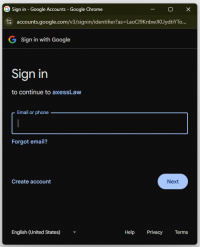
If you want to continue by signing in with Google, you can enter the email of your existing Google account, click Next, and follow the Google sign-in steps to log in through your Google account.
4. User Account
This application features a comprehensive user management system that allows users to manage their accounts fully. Within this system, you can update your profile information, such as name, email, and contact details, as well as customize your account settings according to your preferences. This includes options for changing your password and controlling privacy settings, ensuring a more personalized and secure user experience.
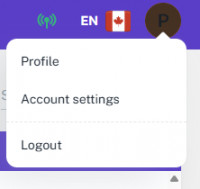
4.1 Profile
4.1.1 Change Profile Image
The application allows users to change their profile images from their account settings easily. This helps personalize the user experience and keeps profiles up to date.
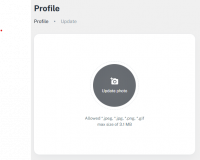
Where it says Upload Photo, click there — a system dialog box will appear, allowing you to choose and upload any picture of your choice.

Once you select the picture and click Open, your profile picture will be successfully updated.
4.1.2 Update User Information
The application provides an option to update user information, such as name, contact details, and email signature. This ensures that user profiles remain accurate and up to date.
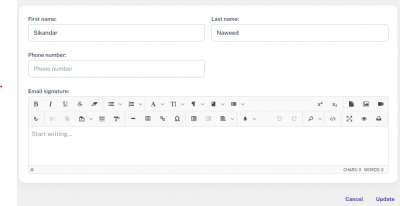
In this section, you have the option to update your first name, last name, phone number, and email signature. You can click on any text field to edit the information. Once you're done, click the Update button to save the changes. At any time, you can also cancel the process and exit the profile management section by clicking the Cancel button.
4.2 Account Settings
Under User Management, there is also an Account Settings option, which includes the ability to change your password.
4.2.1 Change Password
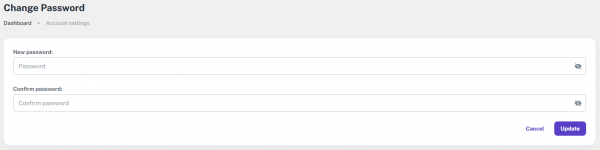
The application includes a change password feature, allowing users to update their login credentials securely. This helps maintain account security and user control.
4.2.2 Password Validation
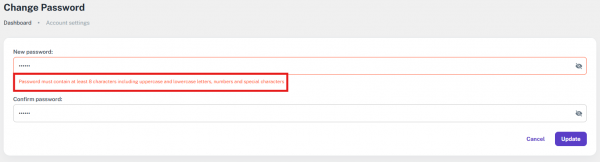
When changing the password, validation rules are applied. If the new password doesn't meet the criteria, an error will be displayed. The first rule is: Password must contain at least 8 characters, including uppercase and lowercase letters, numbers, and special characters. An error message will be shown accordingly if the password doesn't follow this rule.
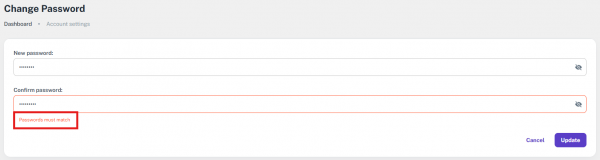
If all the password rules are followed but the values in both password fields do not match, then the second rule applies: Passwords must match. If this rule is not met, an error message will be displayed accordingly.
Once both rules are fulfilled — the password meets all validation criteria and both password fields match — click the Update button to change the password successfully. If the user wishes to cancel the process at any time, they can click the Cancel button to exit the User Management section.
4.3 Logout
The application includes a logout option, enabling users to end their session securely. This ensures user data privacy and prevents unauthorized access.
5. User Management
The application also includes a fully functional User Management module. You are directed to this module when you navigate to the “Users” section from the Admin sidebar.
On the main screen of the User Management module, you will see a complete list of all registered users. Each entry displays important details such as the user's title, name, role, email address, and account status. Additionally, there is an action column provided against each user, allowing admins to perform actions like editing user information and activating/deactivating accounts.
This module gives administrators full control over user-related operations and helps maintain a structured and secure environment within the application.

At the top of the User Management screen, the first feature you'll see is a search bar. This allows you to search for users by their name or email address, making it easy to quickly locate a specific user from the list.
Next to the search bar is an “Export” button. When you click this button, the entire list of users is instantly downloaded to your device in CSV format. This feature is especially useful for reporting, record-keeping, or sharing user data in a structured and portable format.

5.1 New User
In the User Management module, the admin has the authority to add new users to the system. This functionality is provided through the “New User” button located at the top right corner of the page.
As soon as you click the “New User” button, a dedicated form window opens where you can enter the details for the new user.
This feature ensures that administrators can easily and securely manage user onboarding directly from the dashboard.
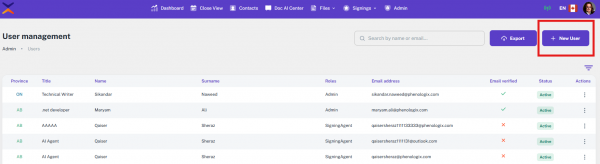
When you click on the “New User” button, a separate form window opens where multiple fields are available for input.
5.1.1 Add New User Form
At the top of the form, there's an option to upload a profile picture directly from your device. Besides that, the form includes various personal information fields, such as:
- First Name
- Last Name
- Email Address
- Title
Toward the end of the form, there’s also an option to add an email signature. This allows for more formal identification and adds authenticity to the user's profile within the system.
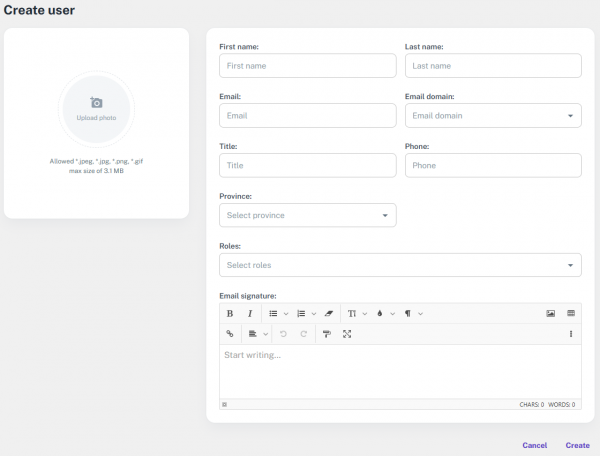
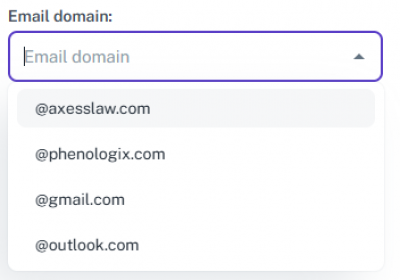
In addition to the personal information fields, the form also includes several drop-downs. The first dropdown is for selecting the email domain.
This dropdown contains a list of registered domains, and the admin can choose any one of them based on which domain the new user’s email should be created under. This ensures that users are added with the correct organizational email structure, and the domain selection remains flexible and controlled by the admin during user creation.
The second dropdown in the form is for selecting the user's province. It provides a list of available provinces, allowing the admin to choose the appropriate one based on the user's location. This helps in accurately recording the user's regional information, which can be useful for administrative, reporting, or policy-based segmentation within the system.

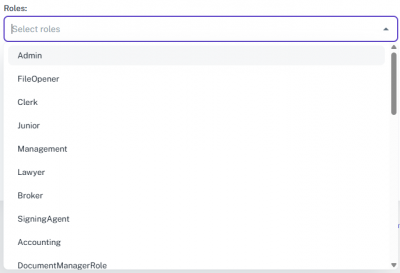
The third and most important dropdown is for selecting the user's role. This dropdown allows the admin to assign a specific role to the user, which is crucial because each role comes with predefined permissions and access levels. By selecting the appropriate role, the admin ensures that the user has access only to the features and sections relevant to their responsibilities, maintaining both security and efficiency within the system.
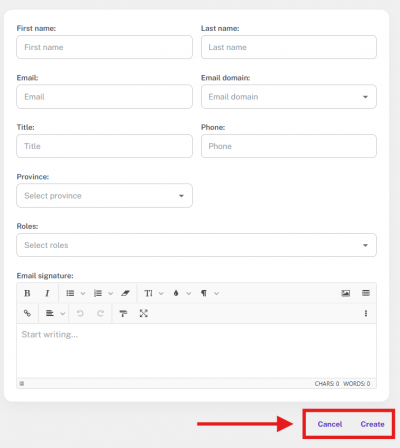
At the end of the form, there are two options: Cancel and Create. If you click Cancel, the form will close immediately, and you'll be taken back to the main User Management screen without saving any information. If you click Create, the system will process the entered details, and a new user will be successfully created based on the provided information.
5.2 Filters
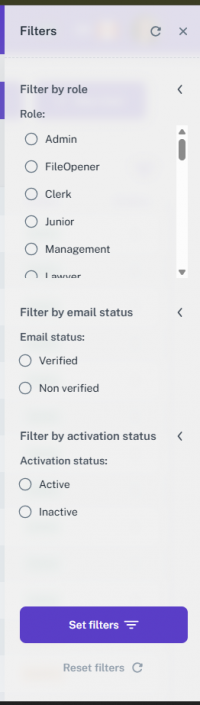
The User Management module also includes a comprehensive filtering system to help admins quickly locate specific users. There are three main types of filters available:
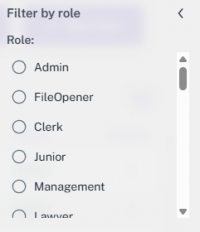
5.2.1 Filter by Role
This allows the admin to filter users based on their assigned roles. From the list of available roles, the admin can select a specific one to view users associated with that role only.
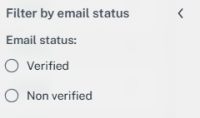
5.2.2 Filter by Email Status
This filter lets the admin choose between verified and non-verified email users. It helps identify users who have not yet confirmed their email addresses.
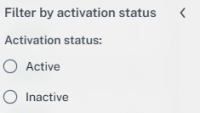
5.2.3 Filter by Activation Status
This option allows filtering users based on their account status. The admin can view either active users or inactive users, depending on the need.
At the end of the filters section, there is a “Set Filters” button to apply the selected filters, and a “Reset Filters” button that clears all applied filters, returning the list to its default state. This makes it easy to manage and refine the user list efficiently.
6. Roles & Permissions
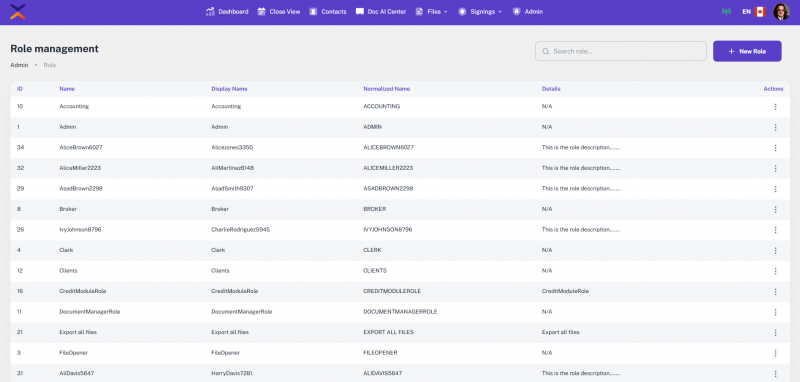
The application also includes a fully functional Role Management module. When you navigate to the “Roles” section from the Admin sidebar, you're directed to this module.
On the main screen of the Role Management module, you can view a list of all roles that have been added to the application. Each role is displayed with the following details:
- ID – Unique identifier for each role
- Name – System name of the role
- Display Name – User-friendly name shown in the application
- Normalized Name – Standardized name used internally for comparisons
- Details – Description or notes about the role
- Actions – Options to edit or delete the role as needed
This module provides a clear overview and control of all user roles, making it easier for the admin to manage permissions and access levels throughout the system.
6.1 Add New Role
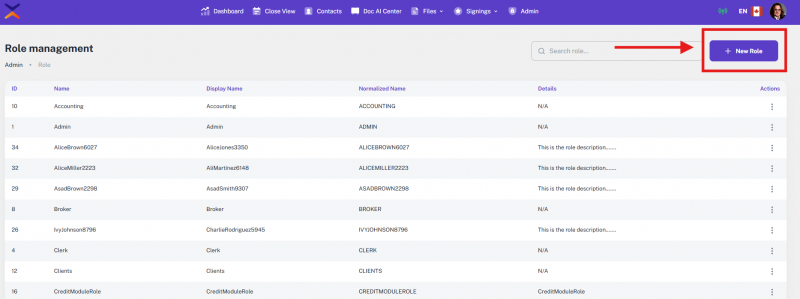
On the Role Management screen, there is a “New Role” button located at the top right corner. When you click on this button, a separate window opens where you can add a new role to the system.
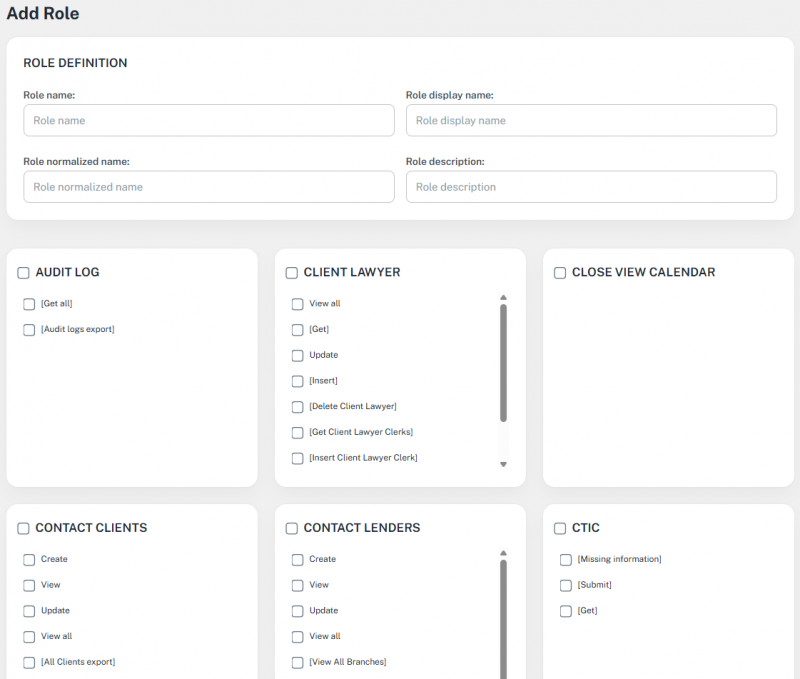
When the “Add Role” form opens, it contains four input fields:
- Role Name
- Role Display Name
- Role Normalized Name
- Role Description
Below these fields, you’ll find a complete list of permissions available across the entire application. While creating a new role, the admin can select exactly which permissions to assign. This allows for full control over what the new role can access or perform within the system, and all permissions are set right at the time of role creation.
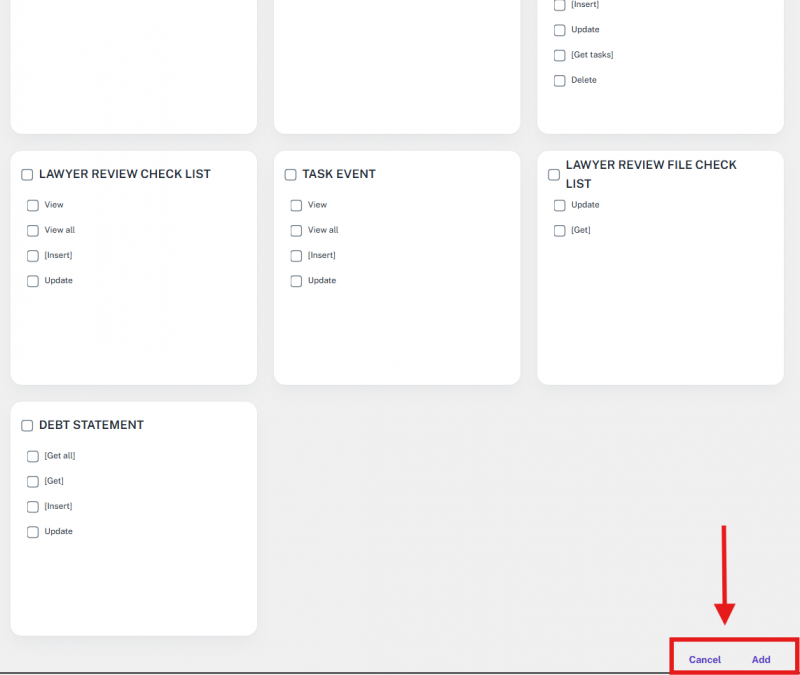
At the end of the Add Role form, after filling in all the fields and selecting the desired permissions, there are two action buttons:
- Cancel – Clicking this will close the form and take the user back to the main Role Management screen without saving any changes.
- Add – Clicking this will create a new role based on the entered details and selected permissions.
Once created, the new role will be reflected throughout the application and will also appear as an option in the User Management module when adding a new user.
6.2 Permissions
The Permissions functionality in this application is highly efficient and well-structured. It allows centralized control over all access levels across the platform. From this single module, permissions for every role can be easily managed.
You have the flexibility to set precise permissions for:
- Each module
- Every view
- And all functionalities within the application
This ensures that users only have access to the features relevant to their role, enhancing both security and usability of the system.

7. Dashboard
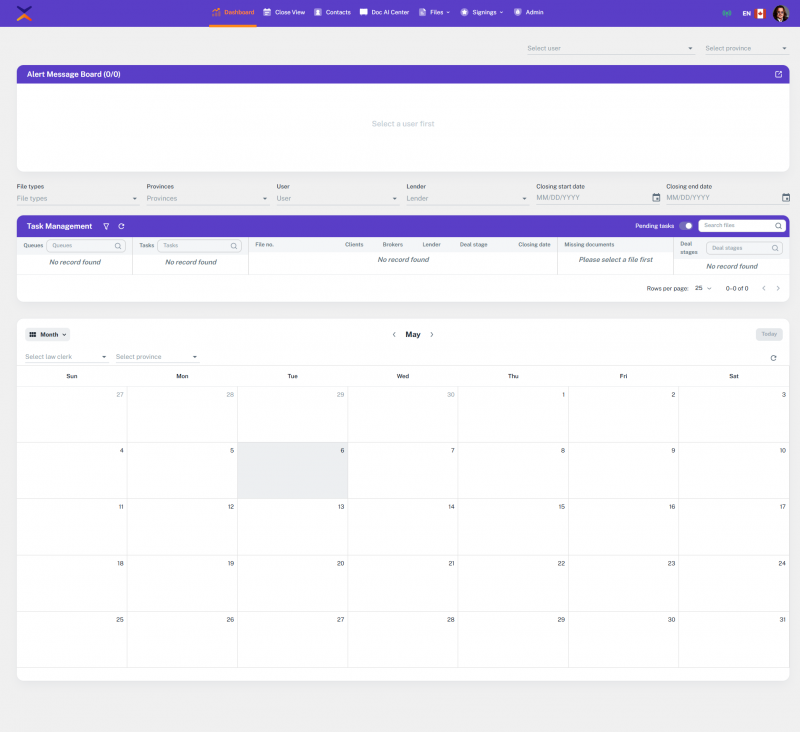
The Rosy Admin Portal dashboard is the command center for users. It’s the first screen a user sees after logging in and serves as a quick access point to all critical information and actions. Designed with clarity and functionality in mind, the dashboard enables users to quickly understand what's happening in the system without needing to delve into different modules.
It displays key metrics, summaries, and real-time data, such as pending tasks, alerts, user activities, and recent updates. This immediate visibility allows users to prioritize their actions and respond to urgent matters efficiently.
A prominent alerts section notifies users of upcoming deadlines, overdue items, or system-wide announcements. The notification panel highlights recent activity, such as task assignments, status changes, or file updates, keeping users aware of everything relevant to their role.
Additionally, the dashboard features a comprehensive task management section, complete with advanced filters. These filters allow users to efficiently search, sort, and locate specific files or tasks based on various criteria. Whether by date, category, status, or assigned user, the filtering system ensures smooth navigation and faster access to the required information, greatly improving productivity and control over daily operations.
Overall, the Rosy Admin Portal dashboard transforms complex workflows into a clean, informative, and action-oriented experience, making it easier for users to manage their responsibilities effectively from a single, unified interface.
7.1 Alert Message Board
The first section of the Dashboard is the Alert Message Board, where all important notifications are displayed. This section keeps the user informed about system alerts, updates, and any actions that require attention, making it a central place to stay up to date with the application’s activities.
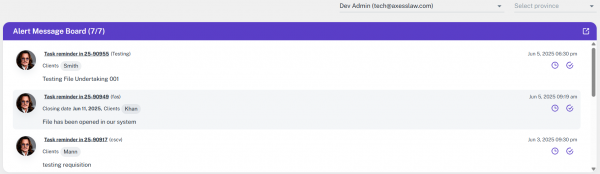
At the top of the Alert Message Board, there are two drop-downs for filtering:
- User Dropdown – Allows you to select a specific user.
- Province Dropdown – lets you choose a province.
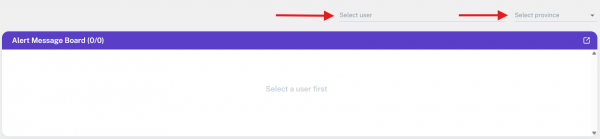
Based on the selected user and province, the alert board dynamically displays notifications relevant to that specific combination. This filtering makes it easy to view targeted alerts and manage notifications more effectively.
Next to the heading of the Alert Message Board, in the top-right corner, there is a pop-up button. When you click on it, a separate window opens showing all notifications along with the user dropdown.
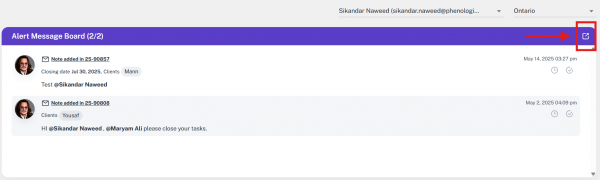
In this popup window, you can also change the user from the dropdown, and the notifications will instantly update based on the selected user. This feature provides a quick and focused view of user-specific alerts without navigating away from the main dashboard.
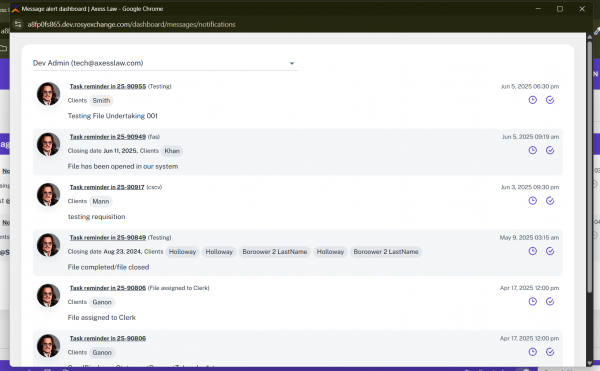
Each alert or notification displayed on the Alert Message Board includes two action buttons beside it.
The first action button appears with a tooltip saying “Remind Me Later” when you hover over it. This feature is designed to let users set a reminder for that specific alert to be notified again later.
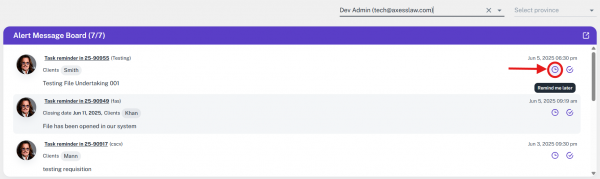
As soon as you click this button, a pop-up window appears where you can select a specific date and time to receive the reminder. Once set, the reminder will be saved by clicking on the save button, and the system will alert the user accordingly at the chosen time.

The second action button is for acknowledging the notification. When you click on it, the selected alert is immediately marked as acknowledged and removed from the Alert Message Board.
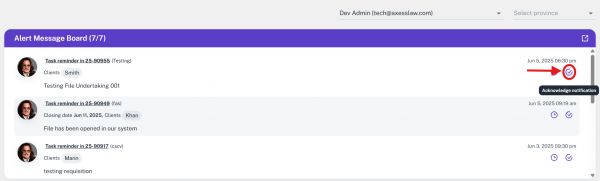
This helps in keeping the dashboard clean by showing only the pending or active alerts, ensuring better focus on unresolved items.
7.2 Task Management
The second section of the dashboard is Task Management, which primarily displays all the files in the system. This section organizes and presents data from multiple perspectives to help users efficiently track and manage their work.
At the top, there is a set of filters including:
- File Type
- Province
- User
- Lender
- Closing Start Date
- Closing End Date
These filters allow users to narrow down the view and locate specific files or tasks quickly.
Below the filters is the main Task Management view, which is divided into five columns:
- Queues
- Tasks
- Files
- Missing Documents
- Deal Stages
This layout gives a comprehensive overview of all ongoing processes, helping users identify priorities, bottlenecks, and pending actions with clarity.
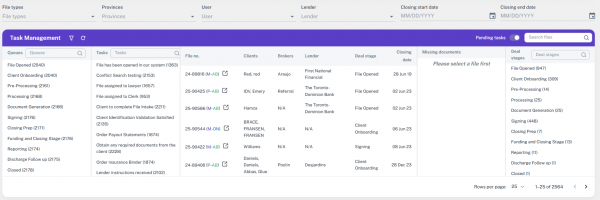
7.2.1 Filters
At the very top of the Task Management section, there is a filter bar containing a total of six filters:
- File Type
- Province
- User
- Lender
- Closing Start Date
- Closing End Date

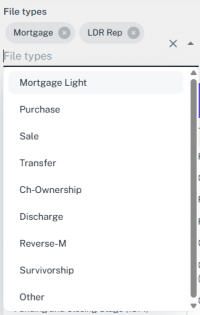
The File Type filter is a multi-select dropdown that lists all available file types in the system. It allows users to select one or multiple file types at the same time. By choosing specific file types from this dropdown, users can easily refine the task view to focus only on the relevant categories, improving both visibility and workflow efficiency.
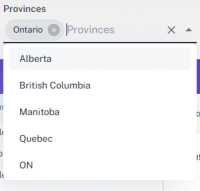
The second filter is for Provinces. This is also a multi-select dropdown that contains a complete list of all available provinces. Users can select one or multiple provinces from this list to filter the task data accordingly. This helps in narrowing down the displayed tasks based on geographical location, making it easier to manage and track province-specific files.
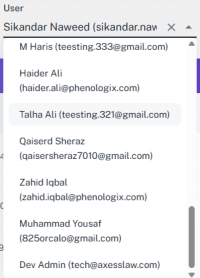
The third filter is the User filter, which is also implemented as a dropdown. It displays the complete list of users in the system. From this dropdown, you can select one user at a time to view the files and tasks specifically assigned to or associated with that user. Unlike the province filter, this is a single-select dropdown, allowing you to focus on the task data relevant to the selected user only.
The fourth filter is the Lender filter, also presented as a dropdown. It contains a list of all the available lenders in the system. By selecting a lender from this list, you can further narrow down the files and tasks displayed, making it easier to focus on data related to a specific lender.

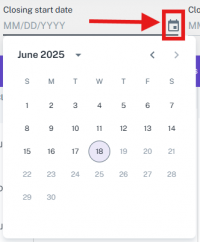
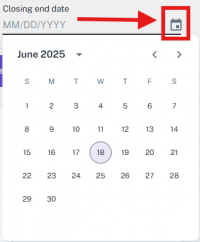
The fifth filter is used to set a specific date. It includes a calendar icon, and when you click on it, a calendar opens, allowing you to select any desired date. This helps in filtering files and tasks based on the selected closing start date for more precise data visibility.
The sixth filter is used to set the closing end date. It also includes a calendar icon, and when clicked, a calendar pop-up appears where you can select any specific end date. This helps in narrowing down tasks and files that are scheduled to close by the selected date, allowing for better tracking and organization.
7.2.2 Task Management View
Below the filters is the main Task Management view, which is divided into five key columns:
- Queues
- Tasks
- Files
- Missing Documents
- Deal Stages
Next to the Task Management heading, there is a “Select Columns” button. This allows users to customize the view by choosing which columns to display. Currently, it provides the option to show or hide two specific columns: Queues and Tasks, helping users focus on the information they find most relevant.

Next to the “Select Columns” button, there is also a “Reset Filters” button. When clicked, it clears all the applied filters and resets the view to its default state, showing the unfiltered, complete data set. This allows users to quickly return to the original view without manually removing each filter.

On the heading bar, at the extreme right, there is a search bar that allows users to quickly locate specific files by entering relevant keywords.
Right next to the search bar, there is a toggle button that lets you switch between Pending Tasks and Closed Tasks views.
- If you select “Closed Tasks”, the system will display only those files that contain tasks marked as closed.
- If the toggle is set to “Pending Tasks”, you'll see all files with tasks that are still open or in progress.
This functionality helps users focus on specific types of tasks for better management and tracking.


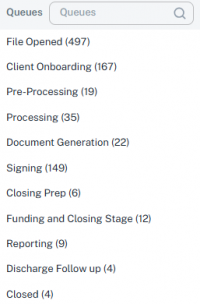
In the Task Management view, the first column is “Queues”, which displays a list of all available queues.
- At the top of this column, there's a search bar that allows you to quickly find any specific queue by typing its name.
- Each queue has a file count shown in brackets next to its name, indicating how many files are currently associated with that queue.
- You can select multiple queues at once, and as you do so, the files displayed in the view will update dynamically based on the selected queues.
This makes it easy to filter and manage tasks by focusing on specific workflows or categories.
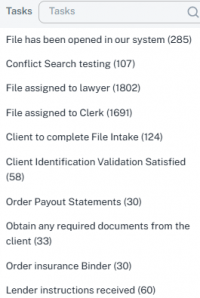
In the Task Management view, the second column is “Tasks”, which displays a list of all tasks within the system.
- At the top of this column, there is a search bar that allows users to quickly search for specific tasks by name.
- Each task in the list shows a file count in brackets next to it, indicating how many files that task is associated with.
- Users can select multiple tasks simultaneously, and based on the selected tasks, the data in the view dynamically updates to show only the files related to those tasks.
This feature allows for focused task tracking and filtering, helping users manage workloads and monitor task distribution more efficiently.
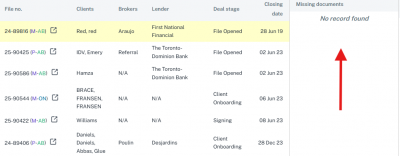
In the Task Management view, the third column is the “Files” column, which displays the actual data records, whether filters are applied or not.
This column presents the core file-level information, including:
- File No – The unique identification number of the file
- Clients – The name(s) of the client(s) associated with the file
- Brokers – The broker handling or linked to that file
- Lender – The financial institution or lender involved in the deal
- Deal Stage – The current progress status of the file in the workflow
- Closing Date – The scheduled or actual closing date for the file
This column acts as the main data display area, updating automatically based on the filters selected from the top (like user, province, lender, date, etc.) or displaying all records when no filters are applied.
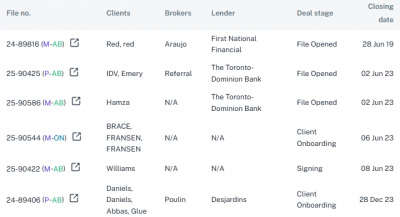
In the “File No” column of the Task Management view, each file number is accompanied by a small “open file” icon. When you click on this icon, it opens that specific file in a separate window or tab, allowing you to view all the details related to that file without navigating away from the main dashboard.
This feature ensures quick access to file-level information while maintaining your current view in the Task Management section.

In the fourth column of the Task Management view, labeled “Missing Documents”, the system displays any documents that are missing for a particular file.
When you click on any file from the Files column, the system checks that file and automatically shows the list of missing documents in this column. This allows users to quickly identify what important documents are still pending for each selected file, helping streamline follow-ups and documentation completion.
And if no document is missing for the selected file, the “Missing Documents” column will simply display the message: “No record found”, indicating that all required documents are already uploaded and complete for that file.
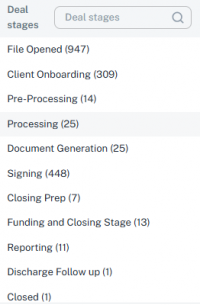
In the fifth column of the view, labeled “Deal Stages”, all the deal stages are displayed. This column also includes a search bar, allowing users to quickly find a specific deal stage by typing its name.
Next to each deal stage, there is a count in brackets indicating how many files currently exist in that particular stage.
Unlike other filters, multiple selection is not allowed here — users can select only one stage at a time, and the view will update accordingly to show files associated with the selected deal stage.
7.3 Calendar
The third section of the dashboard is the Calendar, which helps users visually track and manage important dates and scheduled activities.
There are three display options available for viewing the calendar:
- Monthly View (default)
- Weekly View
- Daily View
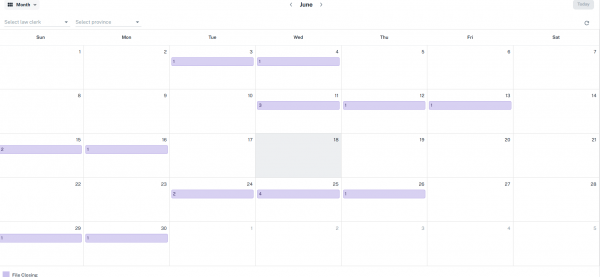
At the top-left corner of the Calendar section, you'll find a view selector dropdown. By default, it shows “Month”, but you can easily switch it to “Week” or “Day” as needed. This flexibility allows users to view scheduled events in broader or more detailed formats, depending on their preference or requirements.
This calendar essentially displays the closing dates of files. For each date, it shows:
- Which files are scheduled to close, and
- A count of how many closings are set for that particular day.
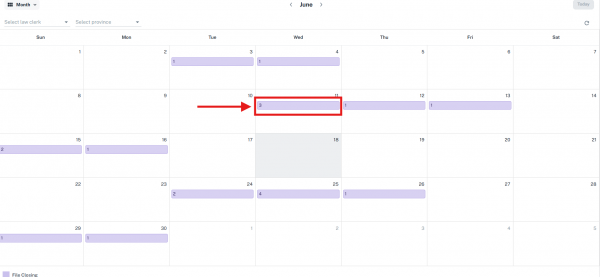
This feature allows users to quickly identify busy days and plan accordingly by simply glancing at the calendar. It's especially helpful for keeping track of workload and ensuring that no important closing deadlines are missed.
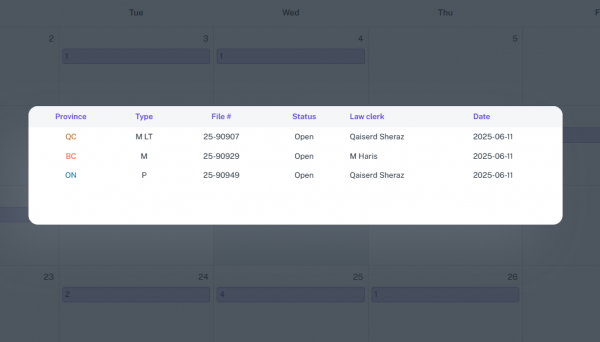
When you click on a specific date in the calendar, a pop-up window opens that displays the detailed information of all the files scheduled to close on that particular day.
This detailed view includes the following columns:
- Province – Indicates the province associated with the file.
- Type – The type of the file.
- File No – The unique identification number of the file.
- Status – Shows the current status of the file.
- Law Clerk – Name of the law clerk assigned to the file.
- Date – The scheduled closing date of the file.
This pop-up helps users get a focused view of daily closings, improving planning and follow-up efficiency.
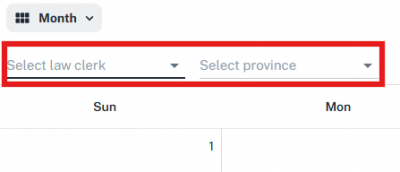
This calendar section also includes filtering options to narrow down the displayed data for better clarity and control.
You can filter the calendar by Law Clerk and by Province:
- The Law Clerk filter lets you select a specific law clerk, showing only the closings assigned to that individual.
- The Province filter allows you to view closings for a particular province.
Only one law clerk and one province can be selected at a time — multiple selection is not allowed.
These filters help users focus on relevant closings based on their role or region, making the calendar view more efficient and personalized.
8. Close View
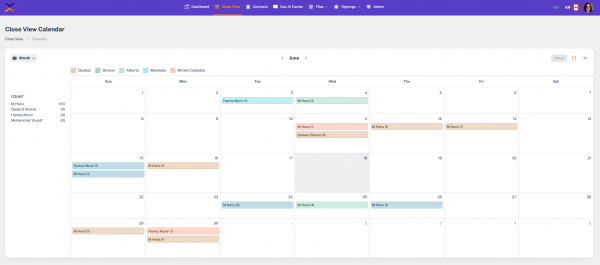
In the Rosy Admin Portal, there's a feature called Close View, located right next to the Dashboard. This section provides a specialized calendar view focused on file closings, helping users get a clear picture of workload distribution across law clerks and provinces.
Key Features of the Close View Calendar:
- Monthly Calendar Display (Default):
By default, the calendar shows the current month, displaying all closing-related data for each day.
- Sidebar with Law Clerks:
On the left side, there’s a sidebar listing all the law clerks’ names.
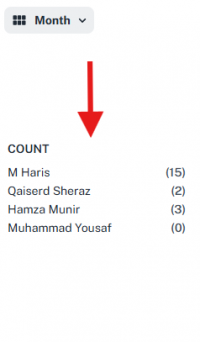 Each name includes a count in brackets showing how many files are assigned to that clerk.
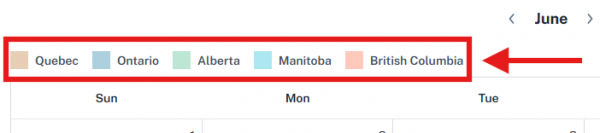
- Province Color Bands:
At the top of the calendar, all provinces are listed, each with a unique color band.
These colors are consistently used in the calendar tiles to visually represent the province of each file.
- Daily Tiles in the Calendar:
Each day on the calendar may contain one or more tiles. Each tile represents a law clerk and displays:
- The law clerk’s name
- The number of closings they are handling on that particular day

If multiple clerks have closings on the same day, multiple tiles will appear, each showing respective clerk-specific details.
This Close View makes it extremely easy for admins and managers to:
- Monitor upcoming closings
- Understand workload distribution by day, clerk, and province
- Quickly identify who is handling how many closings and when
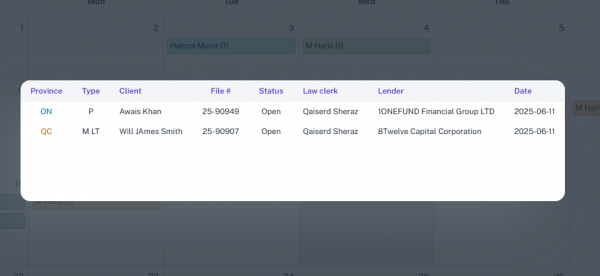
When you click on a specific tile in the calendar, a pop-up window opens that displays the detailed information of all the files scheduled to close on that particular day.
This detailed view includes the following columns:
- Province – Indicates the province associated with the file.
- Type – The type of the file.
- File No – The unique identification number of the file.
- Status – Shows the current status of the file.
- Law Clerk – Name of the law clerk assigned to the file.
- Lender - The financial institution or lender involved in the deal
- Date – The scheduled closing date of the file.
This pop-up helps users get a focused view of daily closings, improving planning and follow-up efficiency.
8.1 Filters in the Close View
In the Close View calendar, there's a filters panel located on the extreme right side of the screen. This filtering feature allows users to narrow down and refine the displayed results, making it easier to focus on specific data points.
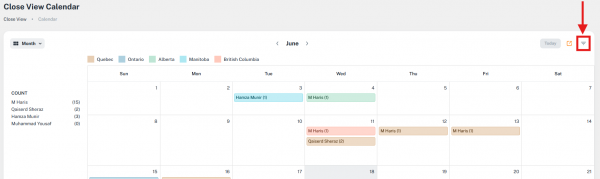
There are three types of dropdown filters available in the filter panel.
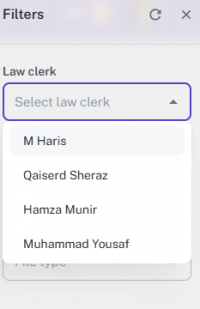
Law Clerk Filter A dropdown list of all available law clerks. You can select one law clerk at a time. The calendar will then only display the closing files assigned to the selected law clerk.
Province Filter Contains a dropdown list of all provinces. Allows selection of one province at a time. Once selected, only the closing entries related to that province will be visible on the calendar.
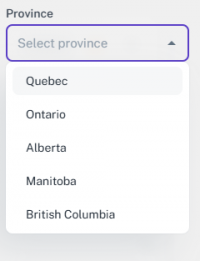
File Type Filter A dropdown showing different types of files handled in the system. You can pick one file type to filter closings shown on the calendar accordingly.

At the end of the filters panel in the Close View calendar, there are two action buttons:
Apply Filters Once you have selected values from any of the dropdowns (Law Clerk, Province, or File Type), Clicking “Apply Filters” will:
- Apply your selected criteria.
- Update the calendar view to show results only matching the selected filters.
- This helps in narrowing down the view to the most relevant data.
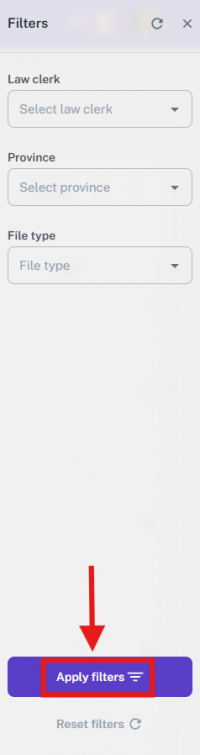
Reset Filters If you click “Reset Filters”, it will:
- Clear all the selections you made from the dropdown filters.
- Reload the calendar view back to the default mode (i.e., showing all closings without any filters applied).
- This is useful when you want to remove filters quickly and view the complete, unfiltered data again.

These buttons ensure users can control and customize their calendar view smoothly and efficiently, enhancing the usability of the Close View feature.
9. Contacts
In the Rosy Admin Portal, there is a section called “Contacts” located right next to the “Close View” tab. This section serves as a comprehensive contact directory for the portal.
Purpose of the Contacts Module: The Contacts module is designed to provide quick access to all essential contact information stored within the application. It centralizes communication details for easier coordination and reference.
Key Features: The main screen displays a list of all contacts available in the system.
For each contact, the following details are shown:
- Full Name – The complete name of the contact person.
- Phone Number – The associated contact number.
- Email Address – The email used for communication or registration.
- Created Date – The date on which the contact was added to the system.
- Registered in Portal – Indicates whether the contact has an active registration in the Rosy Portal.
- IDV Status – Shows the status of identity verification (e.g., Verified / Pending / Not Started).
- Status in Portal – Indicates the contact’s engagement or activity level in the portal.
- Status – General status (e.g., Active, Inactive, or any other tag defined by the system).
- Actions – Provides admin users the ability to edit or delete the contact as needed.
This Contact module is designed to allow administrators to efficiently manage communication, track portal usage, and verify contact legitimacy. It is particularly useful for maintaining a clean, organized, and searchable contact database across the entire application.
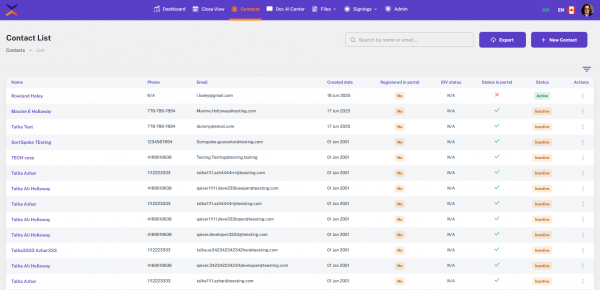
In the Contacts view, the very first element located at the top right corner is a search bar. This search functionality allows you to quickly locate a specific contact by typing keywords such as the name, email address, or phone number.
This makes it easy to filter through a large number of contacts without manually scrolling, helping you find the exact record you're looking for efficiently.

Right next to the search bar, there is a “Export” button. When you click on this button, it instantly generates a CSV file containing the data currently visible on the screen.
This file is then automatically downloaded to your device, allowing you to keep a backup, share the contact list externally, or analyze the data in spreadsheet software like Excel. This feature is especially useful for reporting and administrative purposes.

9.1 New Contact
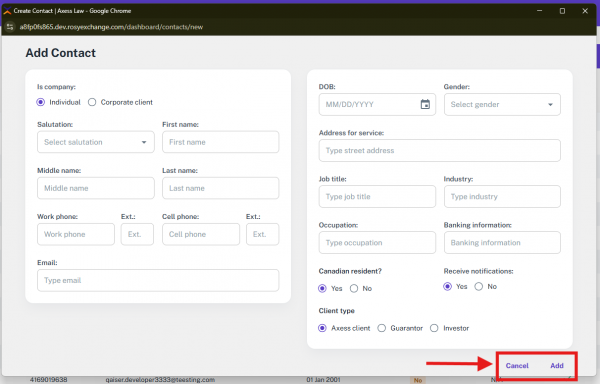
Next to the Export button, there is another button labeled “New Contact”. When you click on this button, a separate window opens up that allows you to create a new contact.

This window contains a form where the admin can enter all relevant contact details.
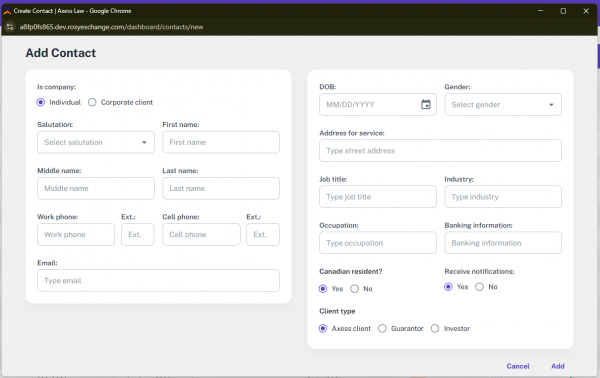
When the new window opens to create a contact, the first field in the form is related to the type of contact, labeled “Is Company”.
This field includes two radio button options:
- Individual – Select this if the contact is a personal client.
- Corporate Client – Select this if the contact is representing a company or organization.
Based on the selection, the rest of the form may adapt slightly to match the nature of the client, ensuring the appropriate information is collected.

If “Individual” is selected: The left side of the form displays fields specifically designed for individual clients:
- Salutation – A dropdown (e.g., Mr., Mrs., Ms., Dr.)
- First Name
- Middle Name
- Last Name
- Work Phone
- Extension (for work phone)
- Cell Phone
- Extension (for cell phone)
- Email Address

These fields ensure that all essential personal and communication details of the individual client are collected properly.
If Corporate Client is selected, the fields on the left side of the form will remain the same as in the Individual case, except that a “Company Name” field will be added at the top of the form.

The right side of the form remains the same for both Individual and Corporate Client types. This section includes the following fields:
- Date of Birth (DOB): A date picker is provided where the user can select their date of birth from a calendar.
- Gender: A dropdown menu allows the selection of gender.
- Address for Service: A text field to input the official address of the client.
- Job Title: The client’s professional designation or role.
- Industry: A dropdown or input field to specify the industry the client works in.
- Occupation: The client's specific job or profession.
- Banking Information: A section to input relevant banking details, if required.
Additionally, there are radio button options for: Canadian Resident: The user must select either Yes or No to indicate residency status. Receive Notifications: This option allows the user to choose whether or not they wish to receive notifications (Yes or No). Finally, the Client Type field allows the admin to categorize the contact by selecting one of the following options: (Axess Client/Guarantor/Investor)

At the end of the form, two action buttons are available:
Cancel: Clicking this button will close the form without saving any information, and the user will return to the main Contact List view.
Add: Clicking this button will save the entered information and create a new contact. The newly added contact will then appear in the contact list.
9.2 Update Contact
In the Contact List, clicking directly on a contact’s name opens a separate window that allows you to update that contact’s information.
This edit functionality is exclusively accessible by clicking on the name — clicking on any other field (e.g., phone number, email, or status) will not trigger the update window.
This design ensures that updates are intentional and controlled, minimizing the risk of accidental edits.
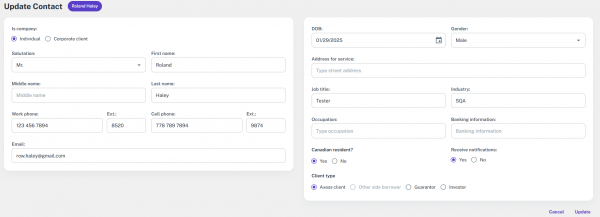
The update contact form mirrors the same structure and fields as the New Contact form.
- If you're editing an individual contact, the form will display fields specific to an individual.
- If you're editing a corporate client, the form will show the corresponding fields for a corporate client.
All fields within the form are editable. You can update any detail as required.
Once you've made the necessary changes, simply click the “Update” button at the end of the form.

All your modifications will then be saved successfully, and the updated information will reflect in the Contact List.
9.2.1 Add Report
When updating a contact, an additional option appears at the bottom of the form labeled “Add Report”.
This allows the user to attach or associate a report with the contact during the update process. It enhances the contact’s record by letting users add relevant documentation, notes, or follow-up details directly from the same window where the contact is being edited.
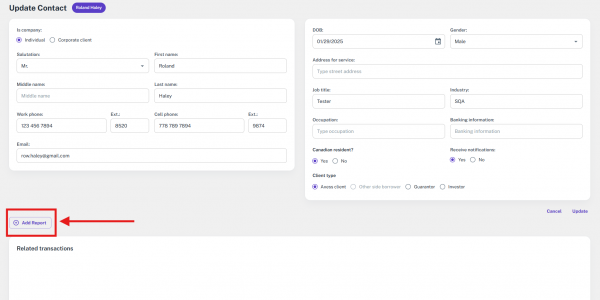
When you click on “Add Report”, a form titled “Report Form” opens up. This form is structured into two main sections:
Section 1: Basic Contact Details This section includes six fields for entering the personal information of the individual:
- First Name
- Middle Name
- Last Name
- Email
- Phone Number
- Date of Birth (with a calendar picker to select the date)
Section 2: Primary Identification Below the contact details, there's a sub-heading labeled “Primary Identification”, which includes five additional fields related to the individual's ID:
- Document Number – a text field to enter the ID number
- Document Type – a dropdown with options like Passport, Driver’s License, National ID, etc.
- Document Expiry Date – a calendar field to pick the expiration date
- Issuing Country – a dropdown or text field to mention which country issued the document
- Issuing Authority – the name of the authority/agency that issued the document

At the end of the Report Form, there are three action buttons:
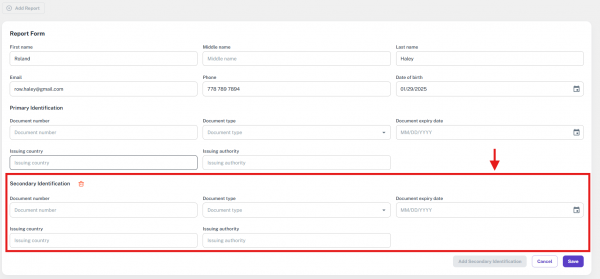
Add Secondary Identification Clicking this button dynamically expands the form and adds a section under the heading “Secondary Identification”. This section includes five fields, identical to the Primary Identification section:
- Document Number – a text input for the secondary ID number
- Document Type – a dropdown with options like Passport, Driver’s License, National ID, etc.
- Document Expiry Date – a calendar picker to choose the expiry date
- Issuing Country – a field to specify the issuing country
- Issuing Authority – a field to enter the authority that issued the document
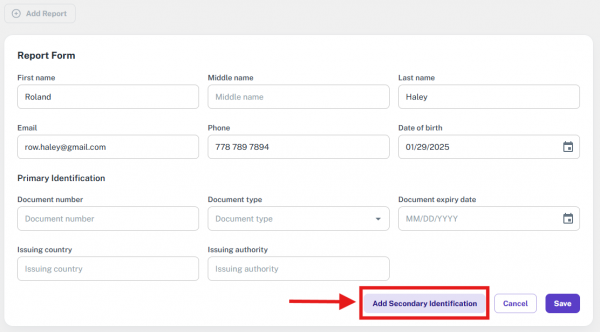
Next to the “Secondary Identification” heading, there is also a delete button, allowing you to remove this section if it's no longer needed.
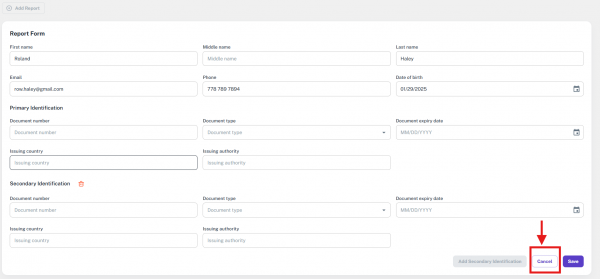
Cancel If you click Cancel, the form will close without saving any data, and the “Add Report” option will reappear in the Update Contact window. You will remain on the same contact update screen, allowing you to take further actions if needed.
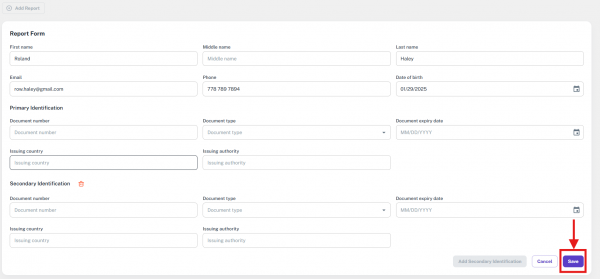
Save If you click Save, all the data entered in the Report Form (including Primary and Secondary Identification if added) will be saved successfully. The report will then be attached to the contact, and you will stay on the Update Contact window with the newly added report reflected in the interface.
10. Doc AI Center
The Doc AI Center allows users to import, review, and validate mortgage, lender, client, and property information extracted from uploaded documents using the SortSpoke API. This helps reduce manual data entry, ensures accuracy, and makes it easier to link documents to the correct file in Rosy.
10.1 Interface
Method 1: Uploading & Assigning New Documents
Use this method when new documents arrive and need to be linked to a file.
Step 1 – Upload Document
- Go to Portal → Doc AI Center.
- Upload the required document (e.g., mortgage package, client forms).
- The SortSpoke API will automatically read the document and extract key values (e.g., property address, lender name, client info).
- Extracted records appear in the Unassigned section.
Step 2 – Assign to File
In Unassigned, click Assign File.
A window opens showing extracted values, such as:
- Mortgage Terms – Principal, Term, Payment, Net Advance, etc.
- Lender Info – Name, Address, Contact.
- Client Info – Borrower, Guarantor, Investor details.
- Property Address – From AI extraction
The system also suggests Possible Matching Files.
Select the correct file and click Assign.
Possible Matching Files
- Based on the extracted data (borrower names, property address, lender info), AI compares with existing files in Rosy.
- If similarities are found, the system lists them under Possible Matching Files.
- This helps prevent the creation of duplicate files or assigning the same client/lender to multiple files incorrectly.
How to Use:
- Review the suggested files shown by the system.
- Compare the AI-Extracted Values with the existing file data.
- If details match → Select that file.
- If details don’t match (e.g., different borrower or property) → Do not select it, instead assign it to a new or correct file.
- Once confirmed, click Assign to finalize.
Method 2: Reviewing Ready-to-Import Data
Use this method when documents are already assigned and ready for validation.
Step 1 – Open Ready to Import
- In Doc AI Center, click Ready to Import.
- A table appears with columns: Search, Name, Finished On, File No, File Type, and Actions.
Step 2 – Compare Values
- In Actions, click Import Data.
- A 3-column comparison view opens:
- Field Name
- AI Extracted Value (from SortSpoke)
- Rosy Value (existing system data)
Step 3 – Choose Actions
- For each field, select one of the options:
- Add as New → Insert new extracted values.
- Replace Existing Value → Replace Rosy values with AI-extracted ones.
- Keep Rosy Value → If AI sends empty/null, the Rosy value stays.
Examples:
- Mortgage: If AI detects a new lender, it will be added unless the lender already exists in Rosy.
- Property: If AI sends a new address, you can choose to replace the old one. Null values will not overwrite existing Rosy data.
- Clients:
- If borrower email matches existing client → link to same client.
- If new → add as a new client.
- For guarantors and investors → AI data is added as new, or existing entries can be updated.
- Lawyers: AI extracts lawyer names, but you must select from Rosy’s registered lawyer list.
Method 3: Re-importing Completed Files
Use this method when a file has already been imported but requires corrections or updates.
Step 1 – Open Completed Section
- In Doc AI Center, go to Completed.
- A list view shows: Search, Name, Finished On, File No, File Type, Actions.
Step 2 – Re-import Data
- In Actions, click Re-import Data.
- The same comparison window opens (AI extracted data or Rosy data).
Step 3 – Finalize Updates
- Replace outdated values with new AI-extracted ones.
- Keep existing Rosy values where needed.
- This ensures completed files remain accurate and up to date.
10.2 Functionality
The integration of SortSpoke AI with the Doc AI Center directly impacts how users work with documents, assign files, and manage client and lender data. Below are the main functional impacts explained step by step:
1. Automated Data Extraction
- When users upload a document, the SortSpoke AI API automatically scans and extracts relevant fields.
- Extracted data includes:
- Mortgage Terms (Principal, Net Advance, Payment, Term, Dates, Interest Rate, etc.)
- Lender Details (Name, Address, Contact)
- File Property (from mortgage package)
- Client Details (Borrower, Guarantor, Investor info, Contact details)
- File Digest (Field name and date)
- This eliminates the need for manual entry of lengthy forms.
2. Unassigned Data Handling
- Extracted records first appear in the Unassigned section.
- Users can:
- Search unassigned docs by Name or Status (Finished / In-progress).
- Open a preview of AI Extracted Values.
- Assign the extracted data to the correct file using the Assign File feature.
3. Smart File Matching
- While assigning, AI suggests Possible Matching Files based on extracted details (e.g., borrower names, property addresses, or lender info).
- This reduces the chance of linking a document to the wrong file.
4. Intelligent Data Import
- In the Ready to Import or Re-import stage, AI data is compared with Rosy’s existing values in a side-by-side view:
- AI Extracted Value (from SortSpoke)
- Rosy Value (system value)
User Options:
- Add as New – Insert extracted data as a new entry.
- Replace Existing Value – Update Rosy with AI value (only when AI value is valid).
- Keep Rosy Value – Prevent overwriting, especially when AI sends a null/empty field.
5. Rules for Lenders
- If the lender extracted by AI already exists in Rosy’s Lender Table, it is not duplicated.
- If it does not exist, the new lender is added automatically.
- For mortgages, AI ensures that at least one lender is always linked to the file.
6. Rules for Clients (Borrower, Guarantor, Investor)
- Borrower:
- If the borrower’s email ID matches an existing client in Rosy, the system links them automatically.
- If not, a new client record is created.
- Guarantor:
- Always added as new entries unless already linked.
- Investor:
- Similar rules as borrowers; system checks email and prevents duplicates.
- Replacement Rule:
- Existing data can be replaced only if AI provides a non-null new value.
- Null values from AI will never overwrite Rosy data.
7. Property Data Management
- AI extracts Property Address, Condo/Collateral details, Jurisdiction.
- If Rosy already has a value:
- AI data can replace existing values if more accurate.
- If AI sends null → Rosy values remain untouched.
8. File Broker & Fees
- AI may extract Broker info and Fees.
- Extracted data is available for validation, but it cannot be overwritten directly with Rosy values.
- Users must manually confirm and update broker-related details if required.
9. Lawyer Information
- AI extracts the Lawyer’s Name from the document.
- In Rosy, lawyers exist as registered users.
- Users must select the correct Rosy Lawyer that matches the AI suggestion.
- This ensures system consistency and prevents duplicate lawyer records.
10. Province-Specific AI Models
- AI behavior adapts depending on the province:
- Ontario: Data is enriched using Teranet integration.
- Other provinces: Data is processed through SortSpoke extraction.
- This ensures higher accuracy for different regions.
11. File Digest Updates
- AI can update File Digest details such as:
- Intended File
- Closing Date
- Other transaction metadata
- These updates keep the file summary consistent and up to date
11. Files
In the Rosy Admin Portal, the “Files” section appears next to the Doc AI Center in the top navigation bar. This module is considered the core component of the entire platform, as it manages the heart of the application: real estate transactions.
The Files module is the most critical part of the Rosy Admin Portal. It is where all legal and transactional records related to real estate cases are created, managed, tracked, and updated throughout their lifecycle. These files represent individual client cases or property-related matters, and the system has been designed to support a wide variety of real estate transaction types.
Each file corresponds to a different type of transaction, which helps the system organize and manage legal workflows efficiently. The supported file types include:
- Mortgage
- Purchase
- Sale
- LDR Representation
- Transfer
- Change of Ownership
- Discharge
- Reverse Mortgage
- Survivorship
These categories cover a comprehensive range of real estate scenarios, from buying and selling properties to more complex legal matters like inheritance, refinancing, and title transfers.
Because each file contains sensitive, time-bound, and legally significant data, this module is deeply integrated with:
- Task management
- Calendar scheduling
- Document automation
- Contact and client communication
- Workflow approvals and tracking
The “Files” module ensures that every real estate transaction is properly documented, processed, and tracked—from initiation to completion—making it an indispensable tool for law clerks, lawyers, and back-office teams using the Rosy Admin Portal.
11.1 New File
Inside the Files module, the very first option you'll see is the “New File” button. This button allows users to initiate a new real estate transaction by navigating to the “Create File” form.
Clicking “New File” takes you to a dedicated form where you can input all necessary details to create a new file in the system. This could be for any type of real estate transaction, such as a mortgage, purchase, sale, transfer, or other legal matters.
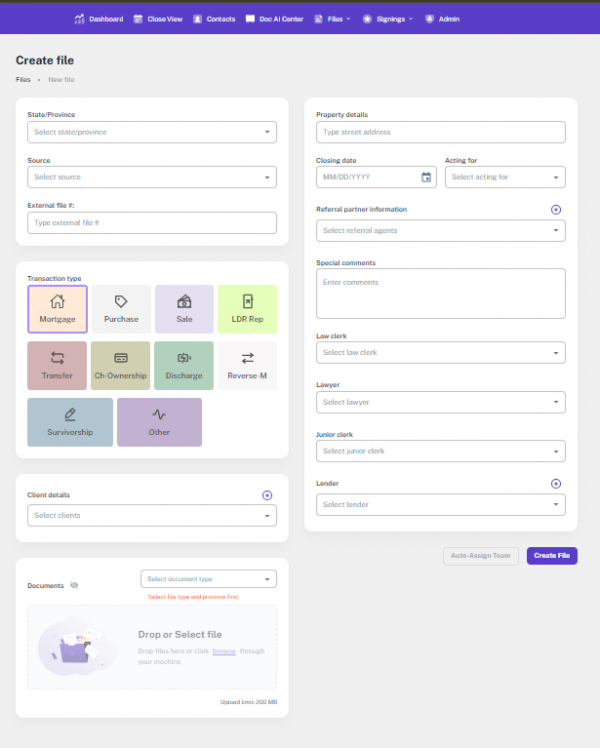
In the “Create File” form, the structure and fields vary based on the selected transaction type.
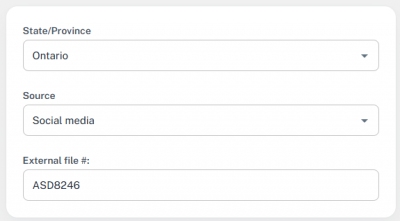
The form begins with three key fields:
State/Province → This is a dropdown field where you can select the relevant province or territory in which the transaction is taking place (e.g., Ontario, Alberta, British Columbia, etc.). It helps ensure the file is associated with the correct jurisdiction, as legal documentation and workflows often differ by region.
Source → Another dropdown field, used to select the source of the file. Selecting the source helps in tracking and reporting the origin of business leads.
External File → This is a text input field where the user can enter an external reference number (if available). This is typically used to store file IDs or reference numbers from outside systems (e.g., lender portals, client management platforms) for easy cross-referencing.
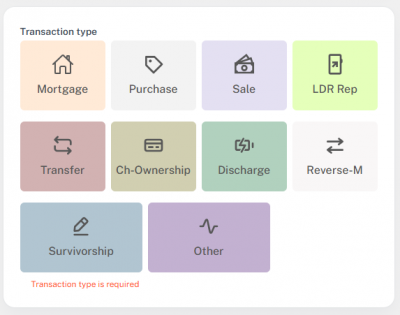
The next section of the Create File form is the Transaction Type selection.
This section contains a set of selectable options that have all supported real estate transaction types, such as:
- Mortgage
- Purchase
- Sale
- Transfer
- Discharge
- LDR Rep
- Change of Ownership
- Reverse Mortgage
- Survivorship
- Other
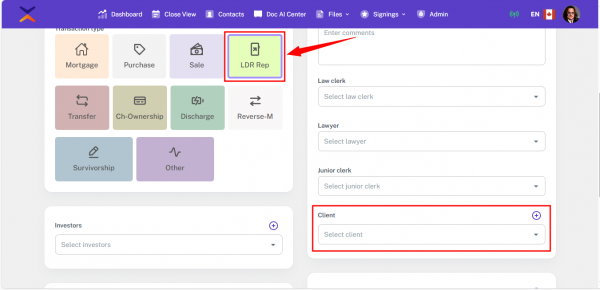
Below the Transaction Type section, the next part of the Create File form is the Client Details section. This section is straightforward and includes only one dropdown field: Client Details → This dropdown allows you to select a client from the list of all previously registered or existing clients in the system.
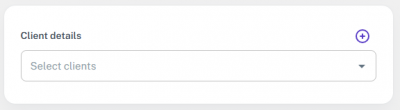
Once a client is selected, their basic information (like contact details, address, and email) may automatically populate in the backend or other sections of the file, depending on the configuration of the system.
The next section of the Create File form is the Documents section.
This section is dependent on two key inputs:
- Province (State/Region)
- Transaction Type
Until both the province and the transaction type are selected, this section will remain empty or inactive.
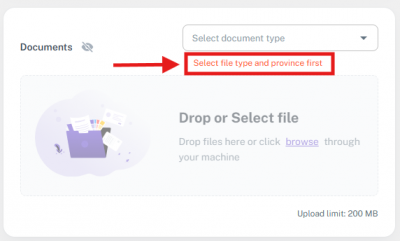
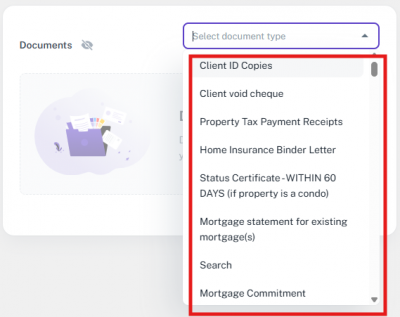
Once you select a province and a transaction type, the system dynamically loads a list of required documents that are relevant to that specific combination. For example → A Mortgage in Ontario may require different forms than a Purchase in British Columbia.
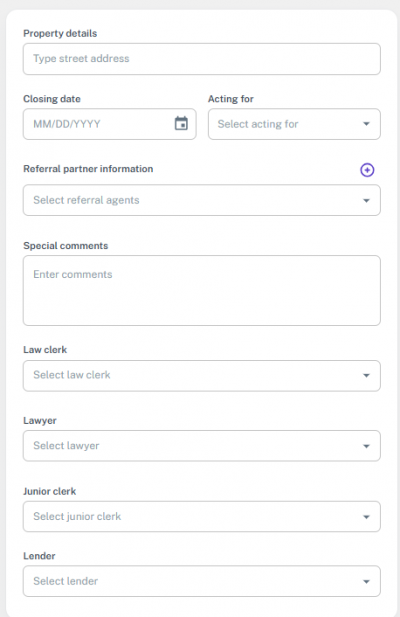
On the right side of the Create File form, there is a dedicated section that contains additional important details needed to finalize the file setup.
Here’s a breakdown of the fields in this section:
Property Details (Text Field) → This is a standard input field where the user can enter the address or description of the property involved in the transaction.
Closing Date (Calendar Field) → A date picker that lets you select the expected closing date for the transaction. This is a key detail that affects timelines and scheduling across departments.
Acting For (Dropdown) → This dropdown allows you to define whom the legal team is representing in the transaction. Options typically include:
- Borrower only
- Borrower and Lender
Referral Partner Information (Dropdown + Add Option) → A dropdown where you can select a referral partner if the file originated from an external source or agency. Next to the dropdown, there’s also an option to add a new referral partner on the spot if it doesn’t already exist in the system.
Special Comments (Text Field) → This is a free-text area where you can enter any additional instructions, notes, or context related to the transaction. It helps other team members understand specific concerns or requirements for this file.
Law Clerk (Dropdown) → Assign the file to a Law Clerk from the available list. Only one can be selected.
Lawyer (Dropdown) → Assign a supervising lawyer responsible for reviewing or signing off on the file.
Junior Clerk (Dropdown) → Optionally assign a junior team member to assist with document prep or follow-ups.
Lender (Dropdown) → Choose the lending institution involved in the file. This list is populated from the system’s lender database and ensures consistency in lender data.
At the very end of the Create File form, there is a “Create File” button.
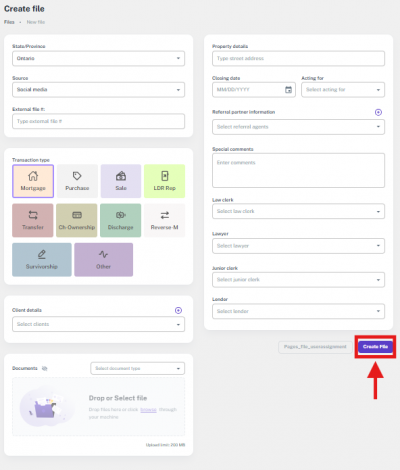
Once all the required fields have been filled out, including transaction details, client selection, document requirements, property and referral information, and staff assignments, you can simply click on the “Create File” button.
As soon as you click it, the system processes all the provided information. If everything is valid, a new file is successfully created in the system. The file will then appear in the main Files module list and can be tracked, edited, and managed from there.
This action finalizes the setup of a new real estate transaction within the Rosy Admin Portal.
11.2 My Files
The second option in the Files menu is “My Files.”
The My Files section displays all the files that are specifically associated with the currently logged-in user. Whether the user is a Law Clerk, Lawyer, Junior Clerk, or Admin, they will only see the files that are assigned to them. This provides a personalized and focused view of responsibilities and ongoing tasks. It helps users manage their workload efficiently without being distracted by files that are not relevant to them.
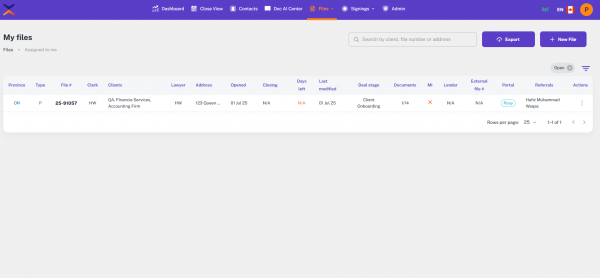
Each file shown here contains key details such as:
- Province
- Type
- File #
- Clerk
- Clients
- Lawyer
- Address
- Opened
- Closing
- Days Left
- Last Modified
- Deal Stage
- Documents
- MI
- Lender
- External File #
- Portal
- Referrals
- Actions
This section plays a crucial role in helping team members stay organized and on top of their assigned transactions.
At the top-right corner of the My Files section, there is a search bar that allows users to locate specific files quickly. As you type, the list below filters in real-time, showing only the files that match the search criteria. This makes it easy and efficient to locate a specific file without having to scroll through the entire list.
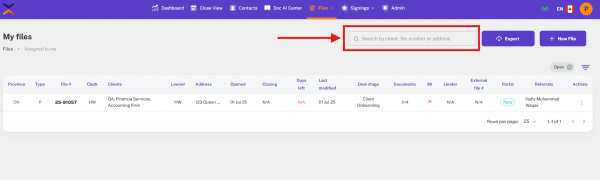
Next to the search bar in the My Files section, there is an “Export” button.
When you click the Export button, the system generates a CSV file containing all the file data that is currently being displayed on the screen. This includes filtered results (if any) or the complete list of assigned files. The CSV file is then automatically downloaded to your device.
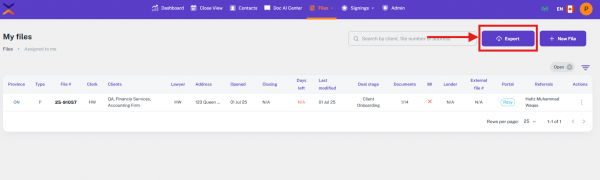
Next to the Export button in the My Files section, there is a “New File” button.
Clicking on the New File button takes the user directly to the Create File form. From there, users can start a new real estate transaction file by filling out all the required fields.
All details related to creating a new file are already thoroughly explained under section 11.1 – New File.

This shortcut ensures that users can easily add new files without navigating back to the main Files menu.
11.2.1 Filters
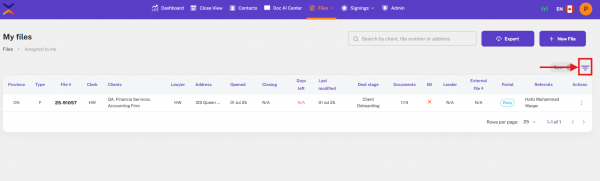
The My Files section also includes a Filters option, allowing users to narrow down the displayed data based on specific criteria. Users can apply multiple filters simultaneously to customize the view according to their needs.
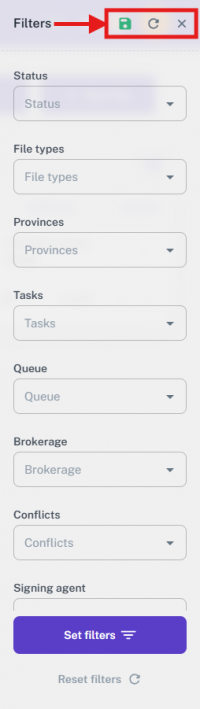
In the Filters sidebar of the My Files section, the top area provides three key control options:
Save Filters → Allows users to save their current filter selections for future use. This is helpful if you often search using the same criteria—just save once and reuse anytime.
Reset Filters → Clears all the applied filters and resets the view back to default, showing all associated files.
Close Sidebar → Closes the filter panel without applying or changing anything, returning to the full-screen file list.
Below the top control buttons in the Filters sidebar of the My Files section, users are presented with several filtering fields to refine their search:
Status → Allows users to filter files based on their current status (e.g., open, closed, in-progress).
File Type → Filters files by transaction types such as Mortgage, Purchase, Sale, LDR Rep, Transfer, CH-Ownership, etc.
Provinces → Enables filtering based on the geographical region or province where the file is being processed.
Tasks → Filters files depending on the tasks associated with them, helping to narrow down by specific workflow stages.
Queue → Lets users filter files by queue category, organizing work by type or team.
Brokerage → Filters based on the brokerage firm associated with a particular file.
Conflicts → Helps in identifying files that are marked with conflict status for compliance or review.
Signing Agent → Allows filtering files according to the assigned signing agent, often used in closing and legal stages.
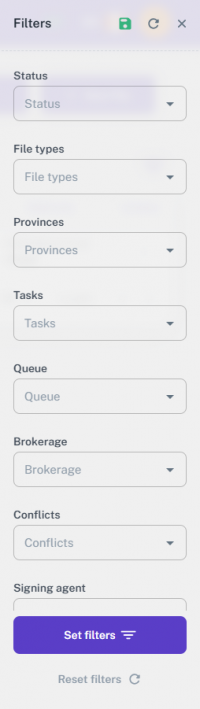
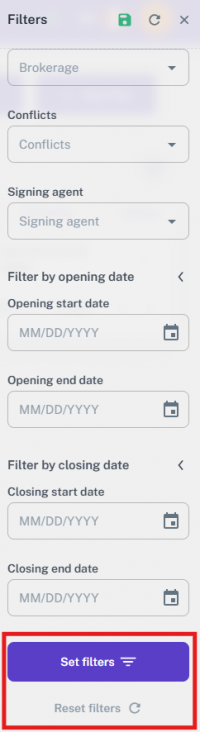
In addition to the dropdown and selection filters, the My Files sidebar also includes date-based filters to refine file searches by timeline:
Filter by Opening Date This filter helps users narrow files based on when they were opened.
It includes two calendar fields:
- Start Date
- End Date
Users can specify a custom range to view files opened within that period.
Filter by Closing Date Similar to the opening date filter, but focuses on when files are expected to or have been closed.
Also includes two calendar fields:
- Start Date
- End Date
Useful for tracking deadlines, planning reviews, or checking recent completions.

At the very end of the Filters sidebar in the My Files section, two action buttons control how filters are applied or cleared:
Set Filters → Clicking this button applies all the selected filters above. The file list will automatically update to display only the data that matches the selected criteria.
Reset Filters → This button clears all selected filters in one click. After resetting, the sidebar closes automatically, and the view returns to showing all available files without any filtering.
11.3 All Files
The third option under the Files menu is All Files.
This section displays every file that exists in the system, regardless of who it is assigned to. It includes:
- All files are assigned to different users
- Any files you have permission to view or access
Unlike My Files, which is limited to the current logged-in user’s associated files, All Files provides a more global view of the data within the application. It's especially useful for admins, managers, or supervisory roles who need visibility across all real estate transactions in the system.
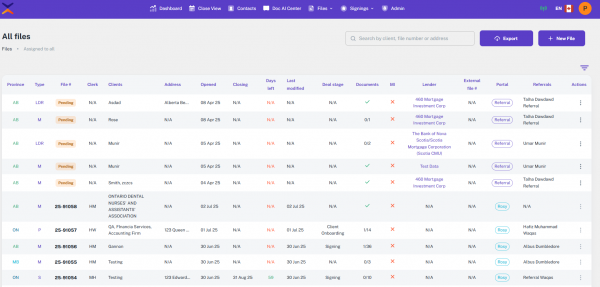
Each file shown here contains key details such as:
- Province
- Type
- File #
- Clerk
- Clients
- Address
- Opened
- Closing
- Days Left
- Last Modified
- Deal Stage
- Documents
- MI
- Lender
- External File #
- Portal
- Referrals
- Actions
12. File Details
12.1 Requisition
The Requisition module is designed to manage the internal documentation and data collection process necessary for initiating and processing a real estate transaction. It serves as a structured form where law clerks or administrative users input essential information required from clients, such as property details, mortgage instructions, identification documents, and any specific legal requirements tied to the deal. This module ensures that no crucial step or document is missed by presenting a standardized set of questions and file upload fields tailored to the type of transaction and jurisdiction (province). The form layout is dynamic; certain sections appear or change based on inputs like transaction type (purchase, sale, refinance) or whether the file involves a lender.
Once submitted, the requisition data becomes an integral part of the file's record and is accessible to authorized team members for review or action. This centralization supports collaboration between lawyers, law clerks, and administrative staff by providing a clear picture of what has been collected and what’s pending. Additionally, it helps streamline the legal workflow, reduce errors, and improve client communication, since the system can notify users of missing requisitions or incomplete data. The Requisition module acts as the foundation for moving a transaction file into active legal processing.
12.1.1 Requisition Template
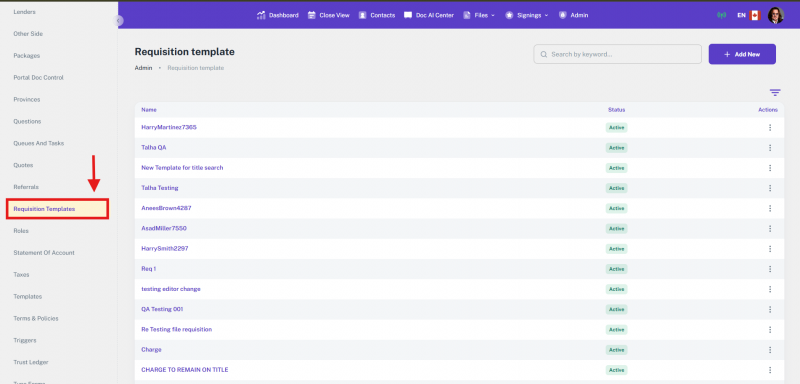
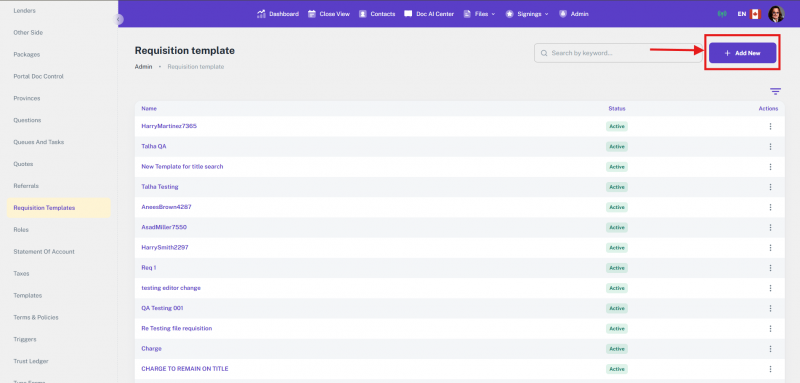
The first feature within the Requisition module is the Requisition Templates, which can be accessed via the admin sidebar. Clicking on this option navigates the user to a dedicated templates screen where all existing requisition templates are listed. Each template includes key details such as its name, associated transaction type or province (if applicable), and its current status (active or inactive). This provides an at-a-glance view of all reusable templates created for different types of real estate transactions.
12.1.2 Add New
In the top-right corner of the Requisition Templates screen, there is an “Add New” button. Clicking on this button opens a form that allows users to create a new requisition template.
This functionality is especially useful for administrators who need to customize the information gathering process for different transaction scenarios. By using the Add New option, organizations can ensure that each template is tailored to suit specific needs, which enhances operational efficiency and reduces repetitive manual entry across files.
12.2 Accounting
The Accounting tab in the Rosy Admin Portal is a key feature designed to manage and maintain all finance and account-related activities associated with real estate transactions. Built specifically for Canadian law firms, this module streamlines critical financial documentation based on the transaction type (e.g., mortgage, purchase, sale, etc.). It centralizes financial operations, including the Statement of Account, Trust Ledger, Statement of Adjustments, Broker Commission calculations, and Unsecured Debts tracking. Each section provides a structured layout to input, view, and manage relevant data, ensuring compliance and accuracy in financial handling.
This feature allows legal teams to monitor and update client financials in real-time throughout the lifecycle of a transaction file. The integration of these accounting components ensures that law clerks, lawyers, and finance personnel can collaborate effectively—minimizing errors, maintaining transparency, and ensuring timely disbursements and reconciliations. The design supports the diverse accounting needs of a legal practice, aligning with Canadian legal standards and transaction workflows.
12.2.1 Statement Of Account
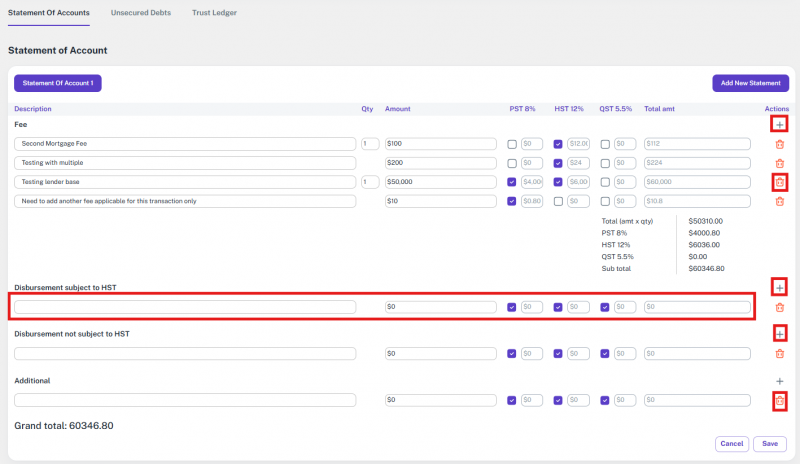
The Statement of Accounts section provides a detailed breakdown of all financial entries associated with a file. This section intelligently auto-populates specific fees based on the File Type and Province selected during file creation. These default fees are configured from the Admin side, ensuring consistency and accuracy across all files. Once a file is created and approved, the pre-defined charges such as legal fees, disbursements, and standard service costs are automatically added to the statement, reducing manual input and streamlining the accounting workflow for legal teams.
1 Transaction-Based Statement View
- Each file can contain one or more custom statement tabs (e.g., Statement of Account 1), allowing itemized entries per file.
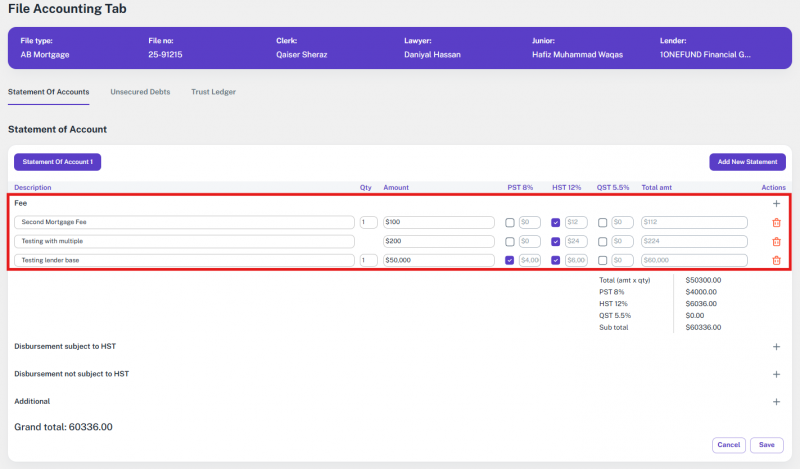
2 Dynamic Fee Description Input
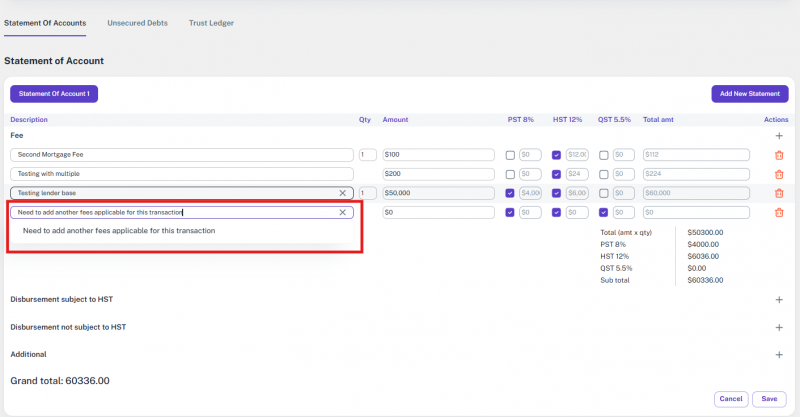
- Fees such as “Second Mortgage Fee” and “Testing lender base” can be entered and customized per transaction. These may be auto-populated based on file type and province as set from the Admin panel.
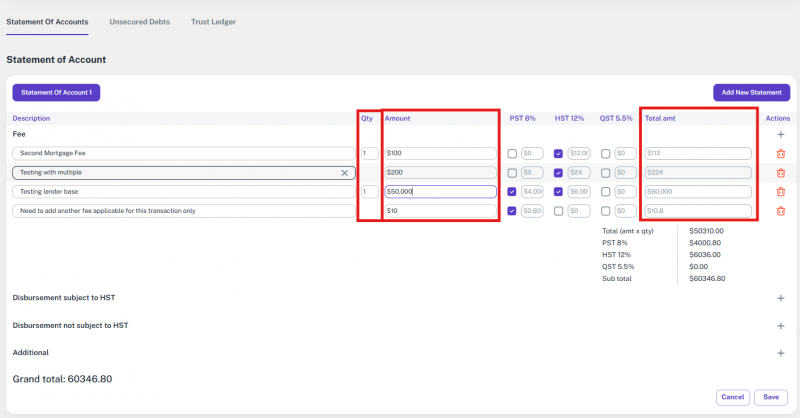
3 Quantity Field (Qty)
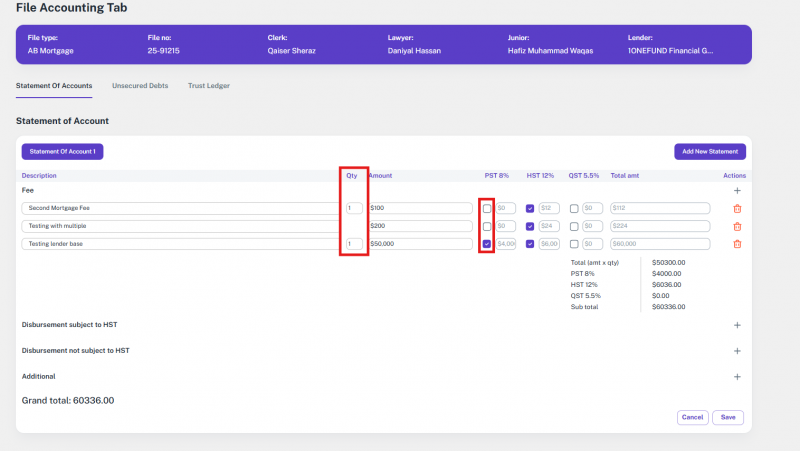
- Adjustable quantity per fee item. Total amount calculations automatically factor in the quantity entered.
4 Flexible Amount Entry
- Custom amounts can be added per fee item in dollars (e.g., $100, $200, $50,000).
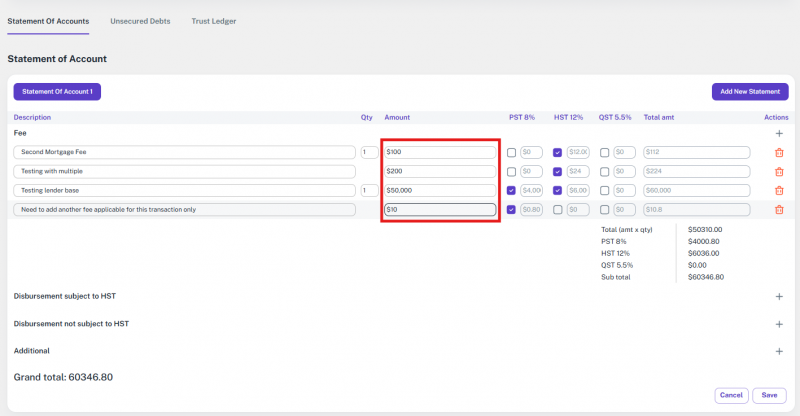
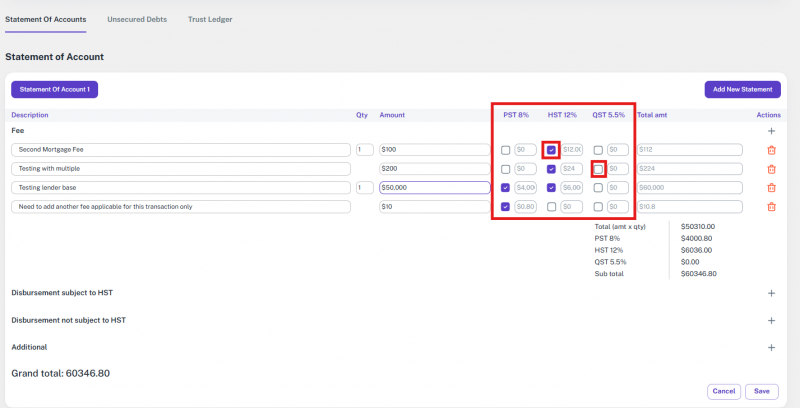
5 Tax Management
Three tax categories are available for each fee:
- PST 8%
- HST 12%
- QST 5.5%
Checkboxes enable selective tax application on a per-fee basis.
6 Automated Totals Per Line
- Each row automatically calculates the total based on quantity, amount, and applicable taxes.
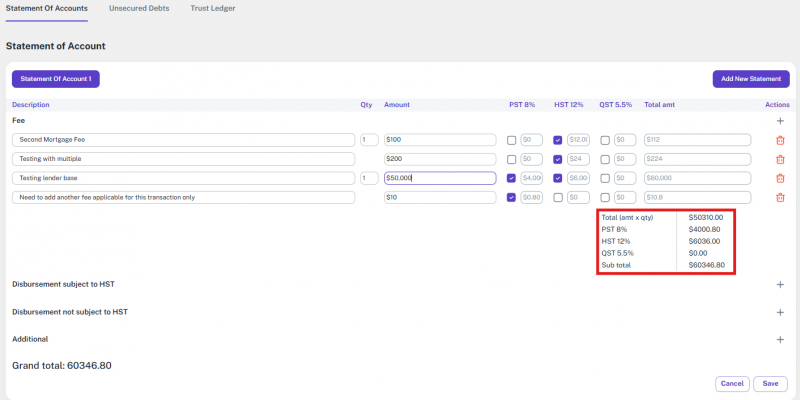
7 Comprehensive Summary
The right-hand column shows:
- Line total (amt × qty)
- Total tax per category
- Subtotal
- Grand Total at the bottom (e.g., 60336.00)
8 Support for Disbursements
Separate areas for:
- Disbursements subject to HST
- Disbursements not subject to HST
- Additional costs if applicable

9 Add/Delete Items
- Add new fee rows to the statement
- Delete individual fee rows
10 Add New Statement Tab
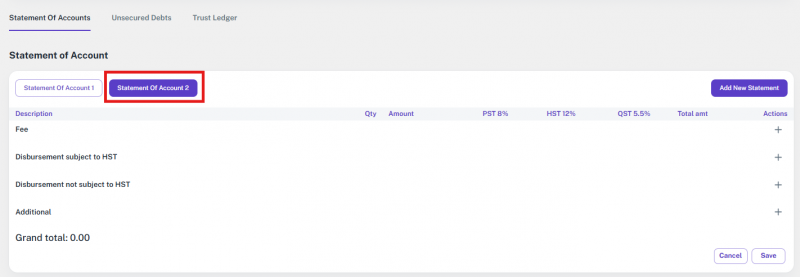
- Ability to create multiple statement tabs per file (via the “Add New Statement” button).

11 Save or Cancel Changes
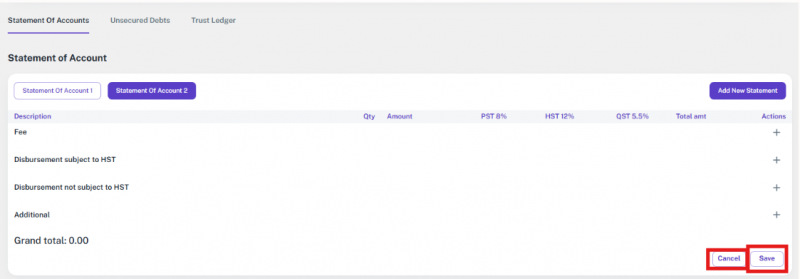
- Bottom-right buttons provide quick options to Save or Cancel the current edits.
12.2.2 Unsecured Debts
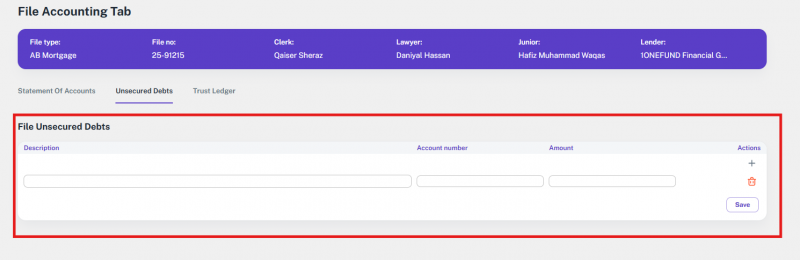
The Unsecured Debts section in the File Accounting Tab allows legal staff to manage and document all unsecured liabilities associated with a specific transaction file. This is a crucial step in tracking outstanding debts that are not secured against property, especially in mortgage and refinancing transactions.
1 Description Field
- Users can enter a clear label or identifier for the unsecured debt (e.g., Credit Card, Personal Loan, Line of Credit).
- This helps in organizing and distinguishing multiple debt entries.

2 Account Number
- This field is used to input the reference or account number associated with the debt.
- It assists in accurate record-keeping and easy identification of creditors.

3 Amount
- Enter the monetary value of the unsecured debt.
- This ensures all liabilities are properly accounted for in the file's financial records.

4 Add Row
- Use the plus (+) icon under the “Actions” column to add a new unsecured debt entry.
- Multiple entries can be added as needed.

5 Delete Row
- Click the trash icon to remove an unsecured debt entry if it was added in error or is no longer applicable.

6 Save Button
- Once the unsecured debt entries are filled in, click the “Save” button to store the data.
- Saved data becomes part of the official file record and may be used in financial summaries like the Statement of Adjustments.

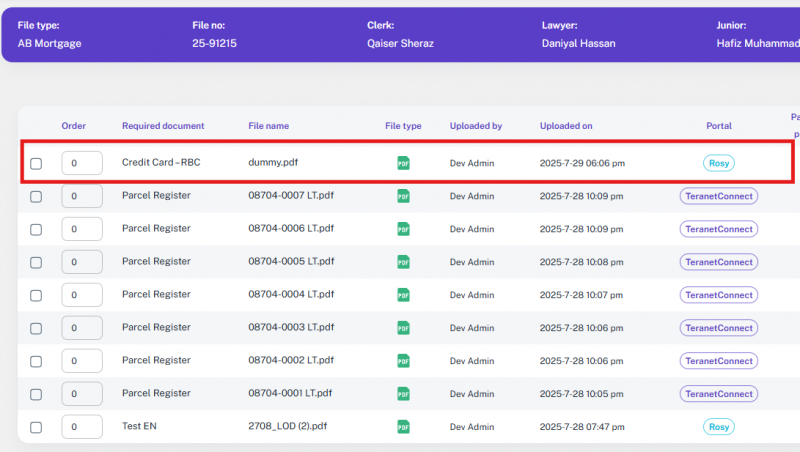
7 Attach Document
- Users have the option to upload any supporting documents related to the unsecured debt directly from the action button.
- Once uploaded, the document is viewable immediately within the Unsecured Debts section.


8 Auto-Sync with File Doc Store
- Any document uploaded in this section is automatically added to the file’s central document store.
- This ensures all relevant documents are consolidated and accessible in one place.
12.2.3 Trust Ledger
The Trust Ledger module is designed to provide a comprehensive summary of all trust-related financial transactions within a file. This section ensures that all financial inputs and outputs tied to a transaction are well-documented, balanced, and traceable. The ledger supports various categories, each playing a critical role in outlining the financial picture of a file:
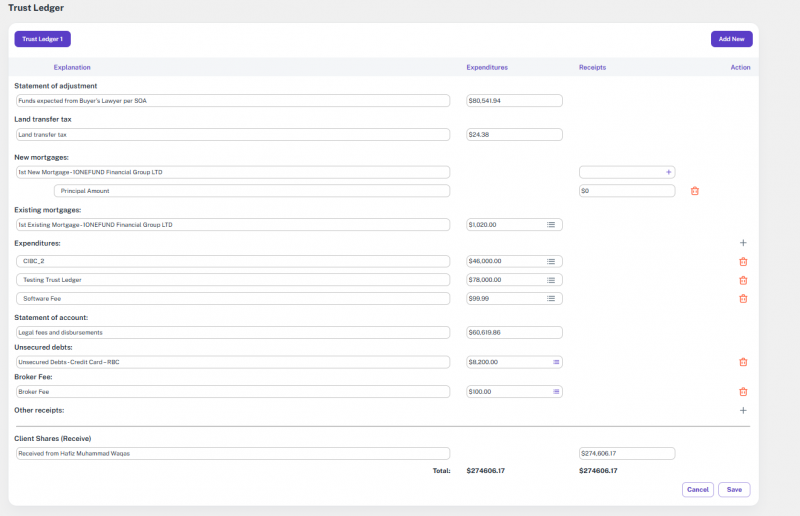
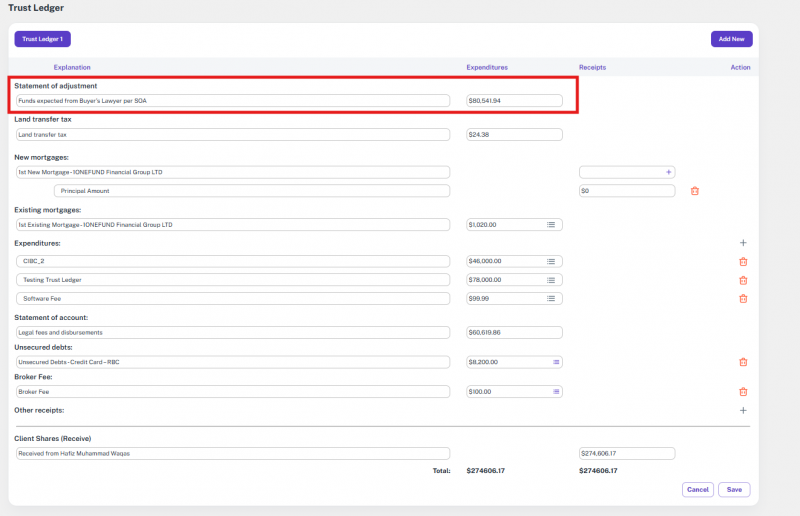
1 Statement of Adjustment
Automatically populated with the amount expected from the Buyer’s lawyer as per the Statement of Adjustment. Users can also modify this field manually if required.
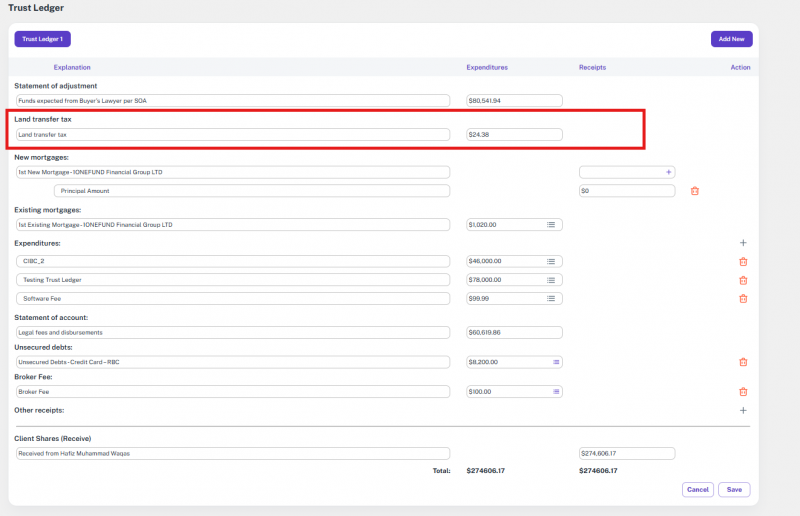
2 Land Transfer Tax
Displays the applicable Land Transfer Tax amount, either fetched automatically or entered manually.
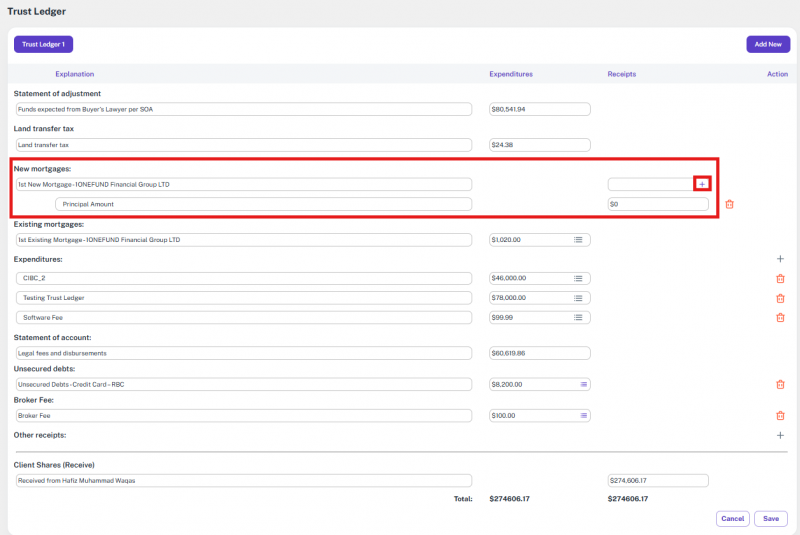
3 New Mortgages
- The entered principal amount is automatically appended to the Trust Ledger. If any changes are made from within the Trust Ledger, they will reflect back in the “New Mortgage” section of the main file record as well.
- Allows users to add one or more new entries. Each new entry has a description and an amount field. Clicking the (+) icon lets you add multiple line items.
4 Existing Mortgages
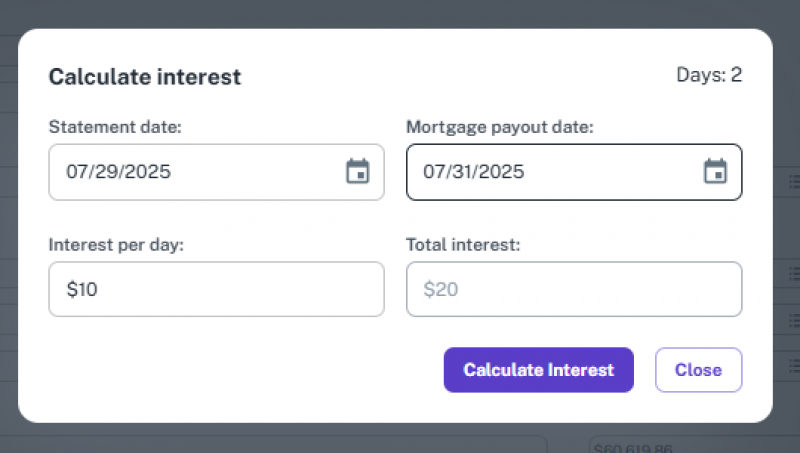
- The payout amounts entered here are also automatically reflected in the Trust Ledger. Any update made to the payout from within the Trust Ledger will update the “Existing Mortgage” section of the file accordingly.
- Enables input of existing mortgage payouts. Each entry displays the lender and the payout amount. The 3-line icon (≡) opens an interest calculator used to determine accrued interest, which is then added to the total payout (discharge to mortgage) in the Trust Ledger.
- This interest calculation feature is not applicable for purchase files. It will not appear or be used in purchase files, and any calculated amount will not be shown in those cases.


5 Expenditures
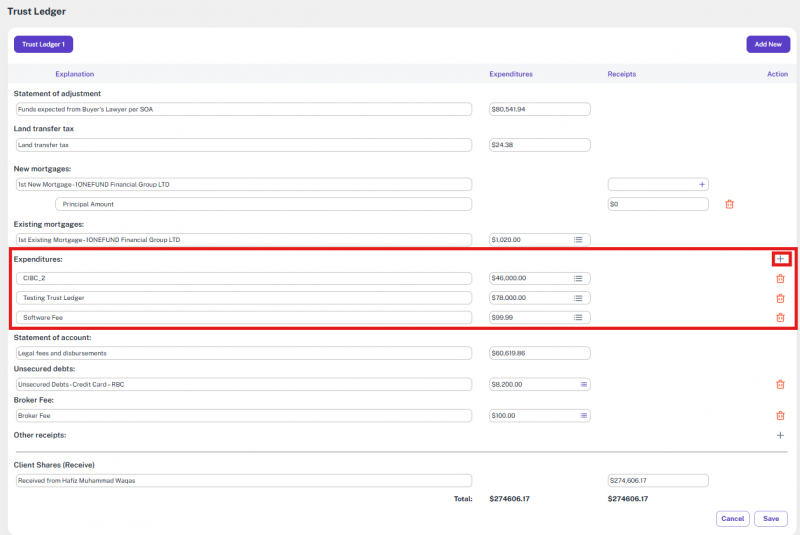
- This is where all the outgoing payments are listed. These could include fees to third parties (e.g., banks, vendors, software charges). Each expenditure can be expanded via the 3-line icon for detailed itemization.
- Allows users to add one or more new entries. Each new entry has a description and an amount field. Clicking the (+) icon lets you add multiple line items.
6 Statement of Account
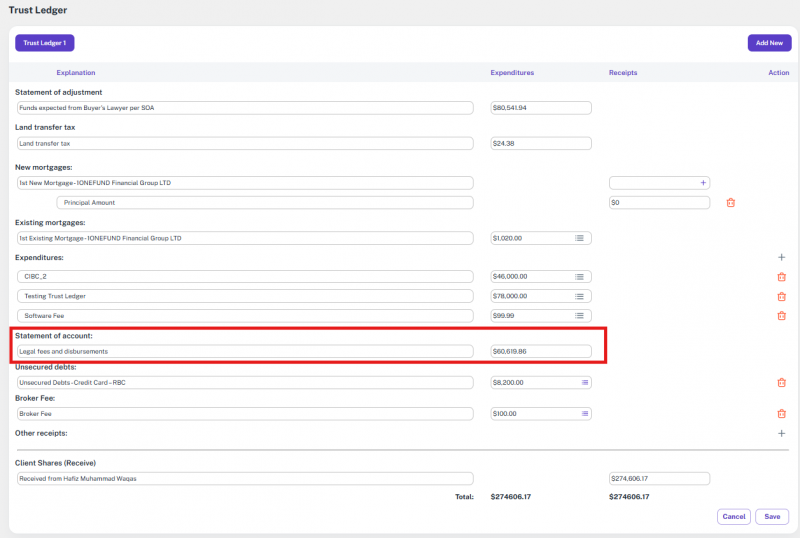
Captures any legal fees, disbursements, or service charges set up from the Statement of Account section. These are auto-populated based on the file type and province.
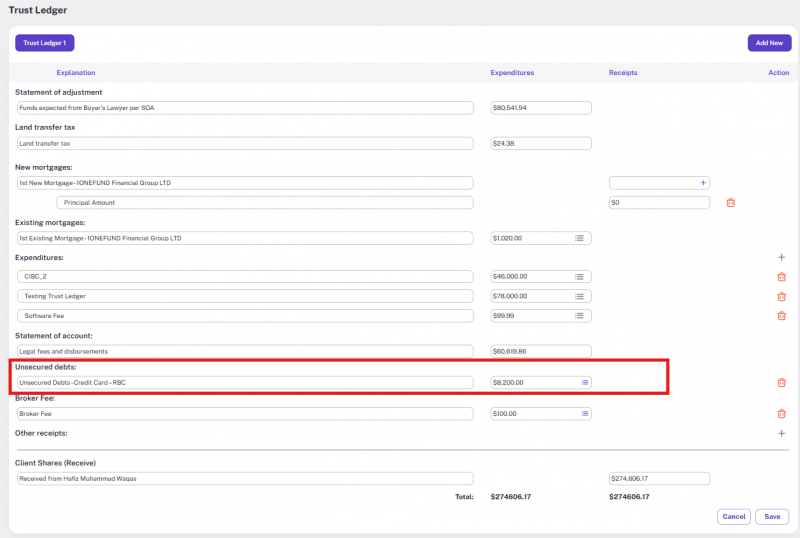
7 Unsecured Debts
Includes credit card or personal debt entries. Each of these can also be expanded for further detail using the 3-line icon.
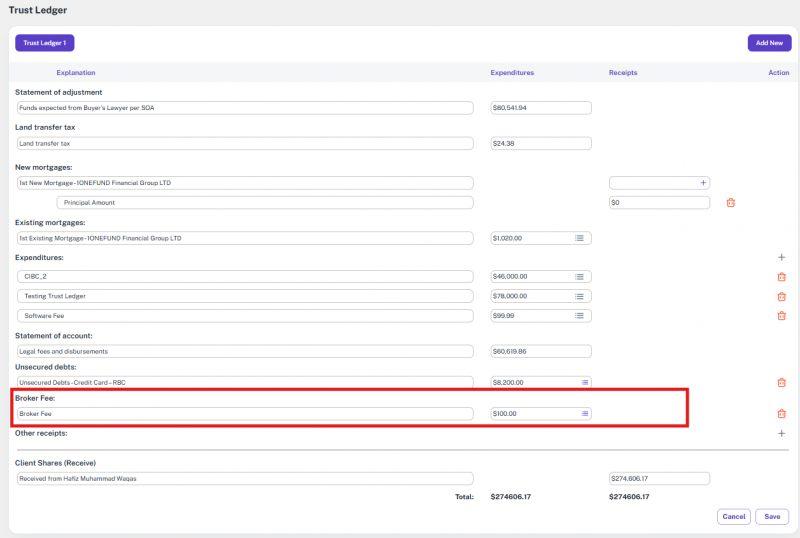
8 Broker Fee
A separate input field for any brokerage fees associated with the file. These can be itemized further.
9 Other Receipts
- A section to enter any miscellaneous receipts not falling into the above categories.
- Allows users to add one or more new entries. Each new entry has a description and an amount field. Clicking the (+) icon lets you add multiple line items.

10 Client Shares (Receive)
This editable field allows entry of the final amount received from the client. The label of this section can be renamed by the user to reflect custom language (e.g., “Received from [Client Name]”).

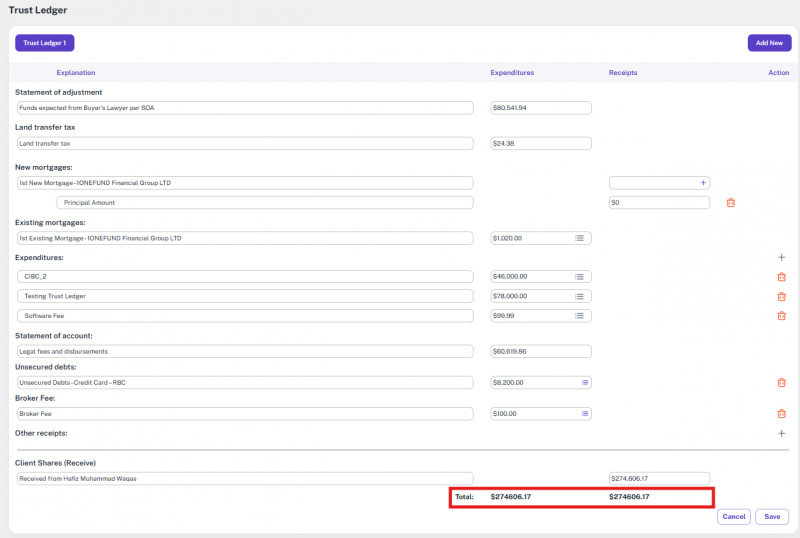
11 Ledger Summary
At the bottom, the Trust Ledger displays the total of all receipts and expenditures. Both sides must match to ensure the ledger is balanced. If there’s a discrepancy, users should review the entries for accuracy.
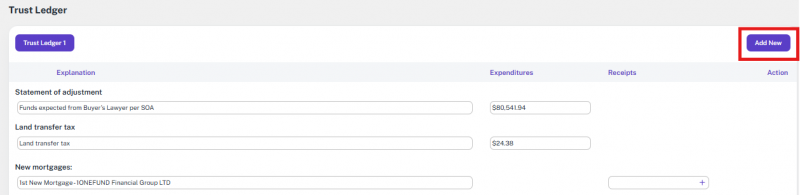
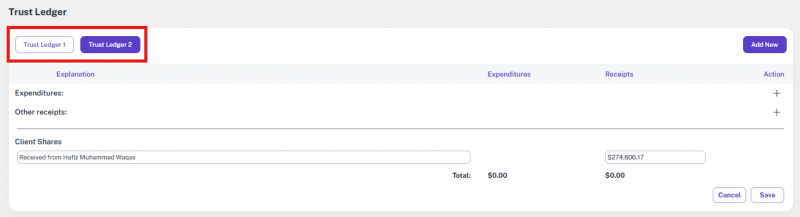
12 Add Multiple Ledgers
- You can create more than one trust ledger using the Add New button at the top-right corner.
- Each new ledger can be customized for specific financial purposes or separate transactions.
13 Expandable Line Items
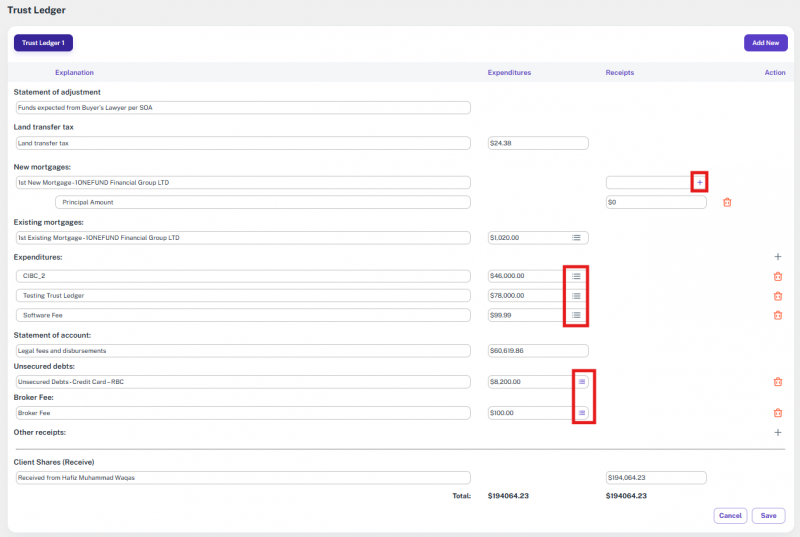
- Many entries (such as New Mortgages, Expenditures, Unsecured Debts, and Broker Fees) feature a three-line (≡) icon.
- Clicking this icon allows users to expand the item and enter additional details or sub-items.

14 Add/Delete Individual Items
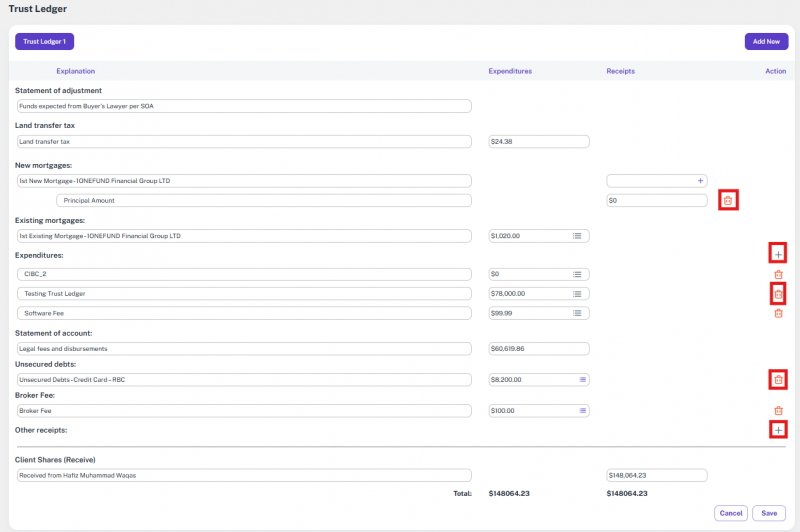
- You can easily add more line items using the plus (+) icon beside each category.
- Likewise, you can delete unwanted entries by clicking the red trash can icon next to each line.
15 Save and Cancel Options
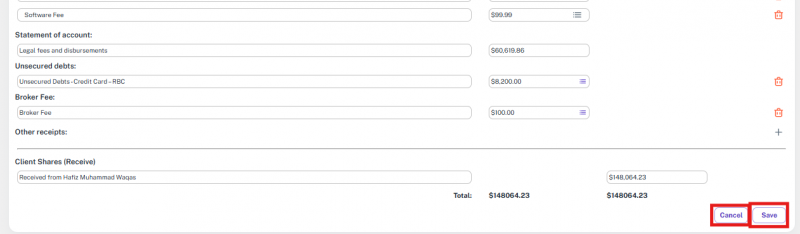
- Once all data has been entered, you can click Save to store the information.
- Use Cancel if you want to discard any unsaved changes.
12.2.4 Statement Of Adjustment
The Statement of Adjustments section allows users to calculate the final amount payable at closing by accounting for the sale price, deposit, applicable adjustments, and credits. Below are the core functionalities and features available within this module.
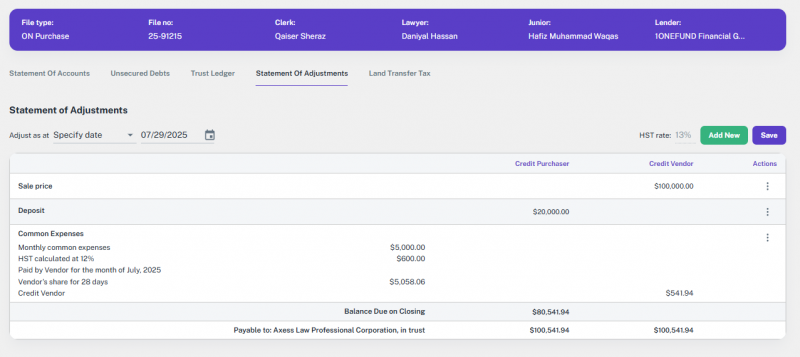
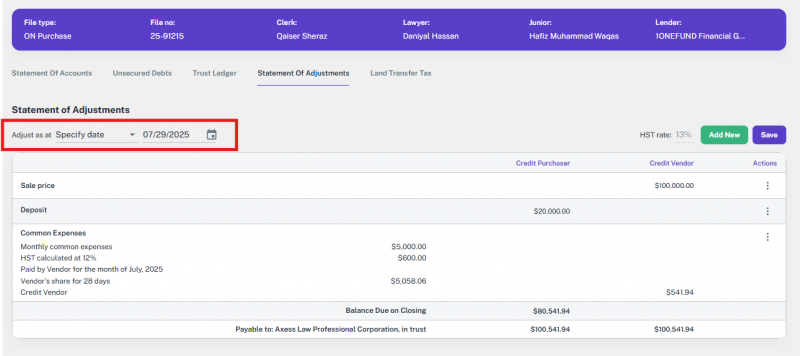
1 Setting the Adjustment Date
- Specify date: Click on the date field to open the calendar and select the specific date you want to use for all calculations. This is typically the closing date of the transaction.
- Closing date: This option automatically uses the closing date of the file.
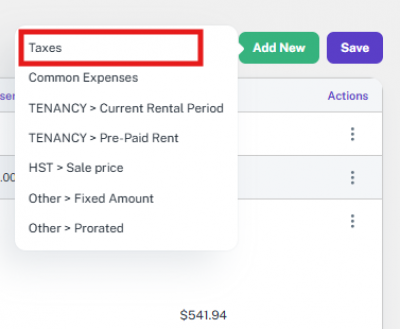
2 Adding a New Adjustment
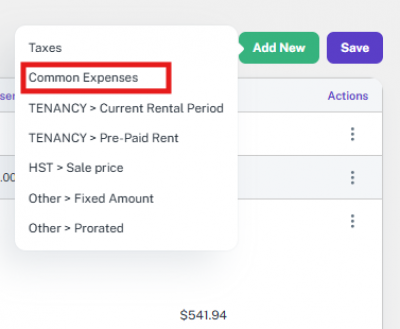
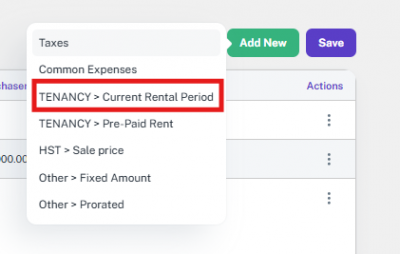
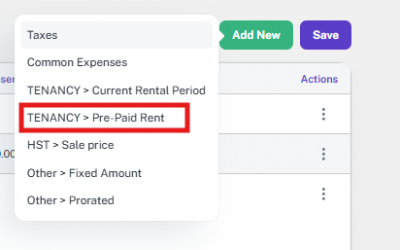
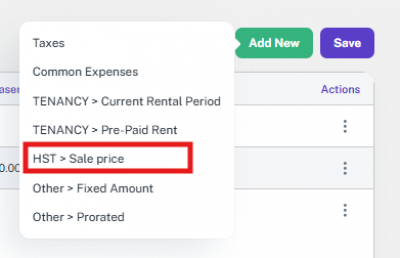
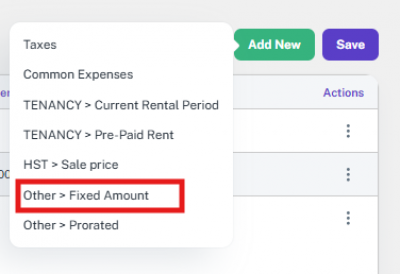
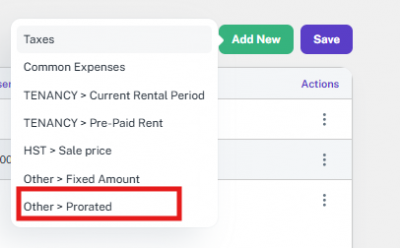
To add a new adjustment, click the “Add New” button. A dropdown menu will appear with the following categories:
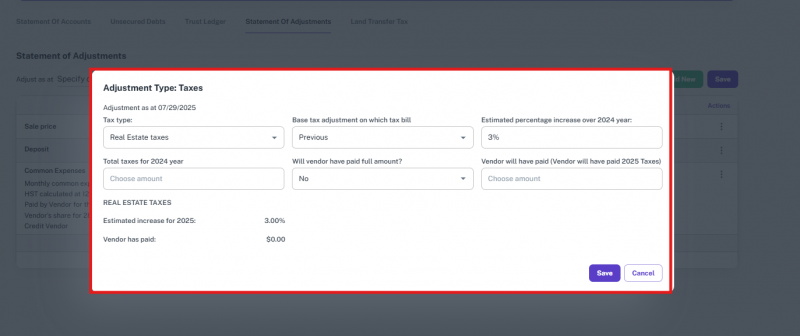
a. Taxes
Use this for real estate tax adjustments. You can input the total tax for a given year, specify a percentage increase, and indicate if the vendor has paid the taxes in full.
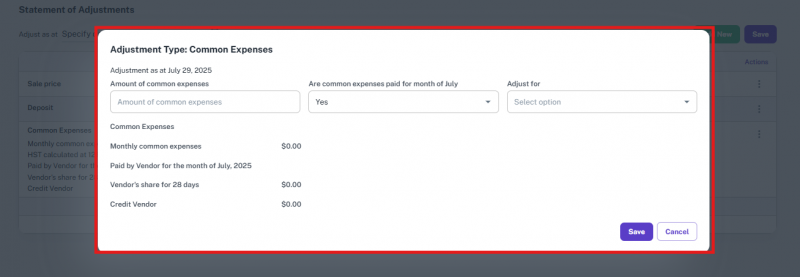
b. Common Expenses
Use this for prorating shared expenses, such as monthly condo or strata fees. Enter the total monthly amount, and the system will automatically calculate the vendor's share based on the adjustment date.
c. TENANCY > Current Rental Period
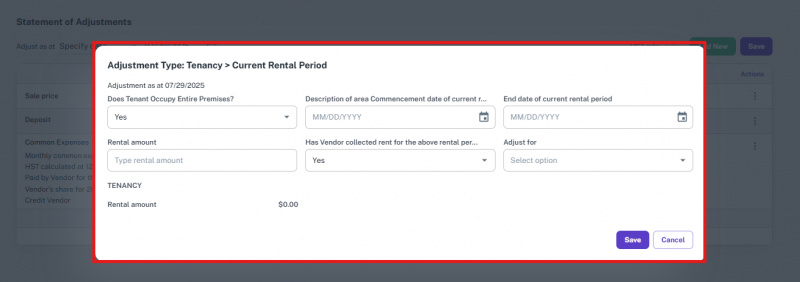
If the property has a tenant, use this to prorate the current month's rent. You will enter the start and end dates of the rental period and the total rent amount. The system will then calculate the credit due to the purchaser for any rent collected by the vendor for the period after closing.
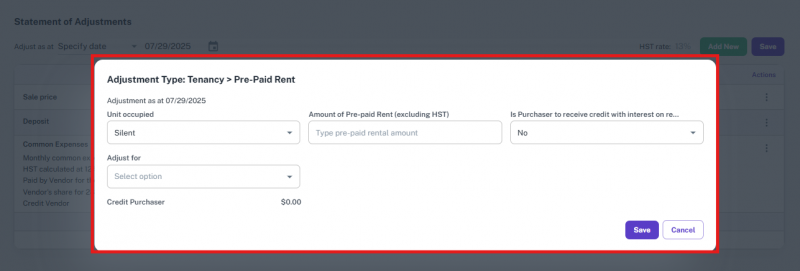
d. TENANCY > Pre-Paid Rent
Use this for situations where a tenant has paid rent in advance beyond the closing date. You can specify the amount of pre-paid rent and whether the purchaser should receive credit with or without interest.
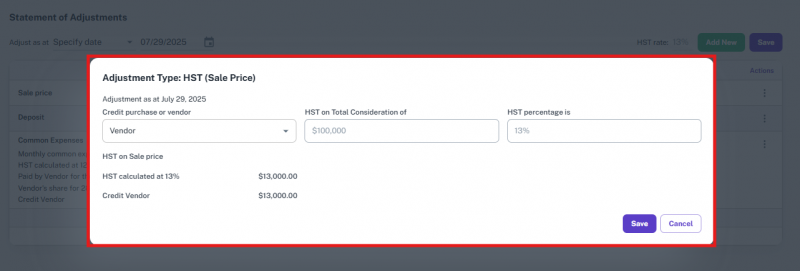
e. HST > Sale Price
Use this to calculate the HST payable on the total consideration of the property. You will specify the party to be credited and the HST percentage.
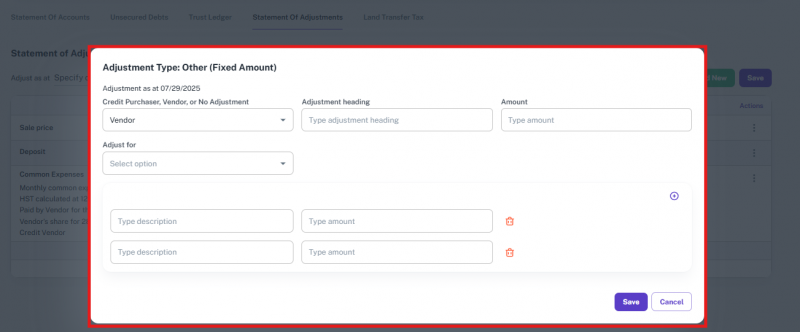
f. Other > Fixed Amount
This is a flexible option for any non-standard, one-time adjustment. Simply provide a heading and a description for the adjustment and the corresponding fixed amount.
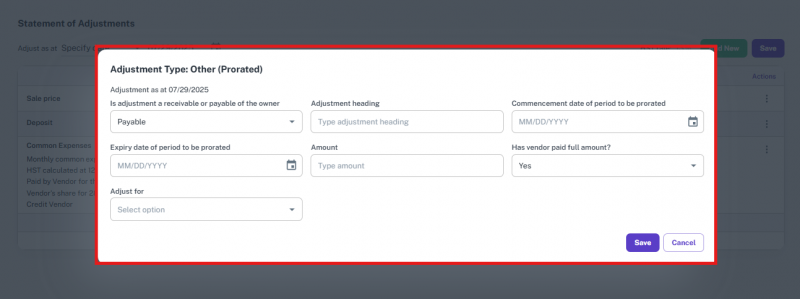
g. Other > Prorated
This option is for custom prorated adjustments that are not covered by the other categories. It allows you to specify a custom period and amount.
3 Saving Your Work
- After filling out an adjustment form, click “Save” to apply the changes and return to the main statement.
- To save all adjustments and the entire statement, click the “Save” button at the top right of the main page.
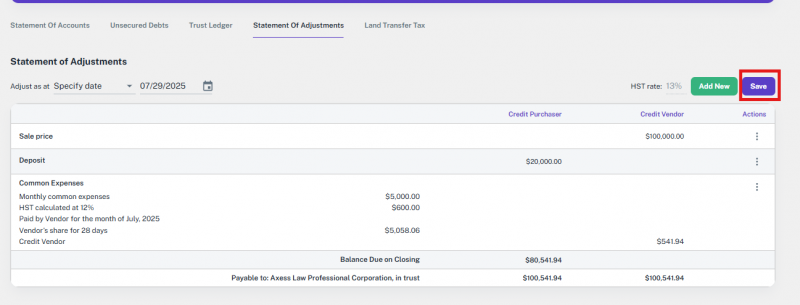
4 Credit Purchaser / Credit Vendor
These columns show which party is receiving credit for each item.
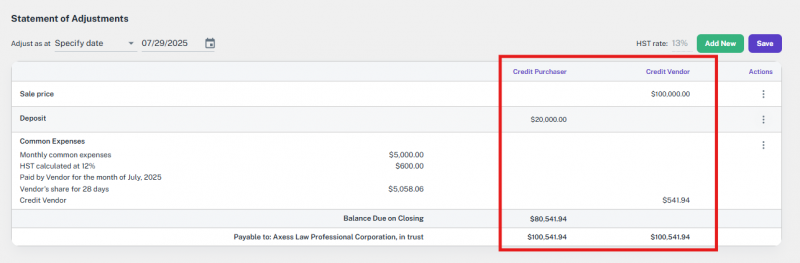
5 Balance Due on Closing
This is the net amount calculated by the system, taking into account all adjustments.
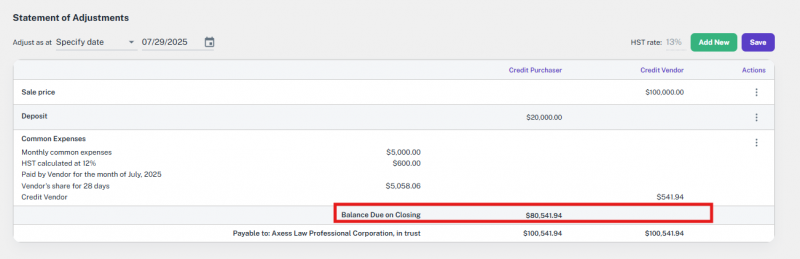
6 Payable to: [Law Firm Name], in trust
This line shows the final total amount that needs to be paid into the law firm's trust account to complete the transaction.
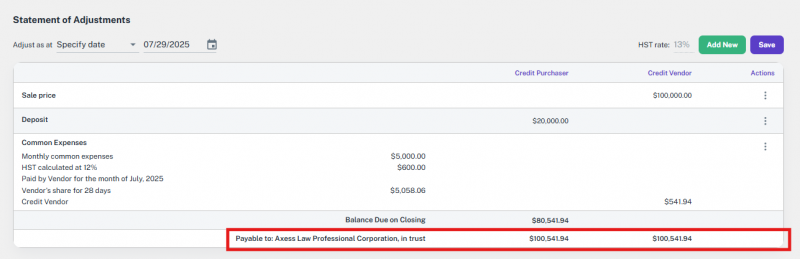
12.2.5 Land Transfer Tax (LTT)
The Land Transfer Tax section allows users to input details required for calculating the applicable LTT based on transaction value and location, specifically tailored for residential property transactions.

1 Prepare LTT Affidavit To Be Executed By
Dropdown field to select who will execute the affidavit (e.g., Client, Lawyer).
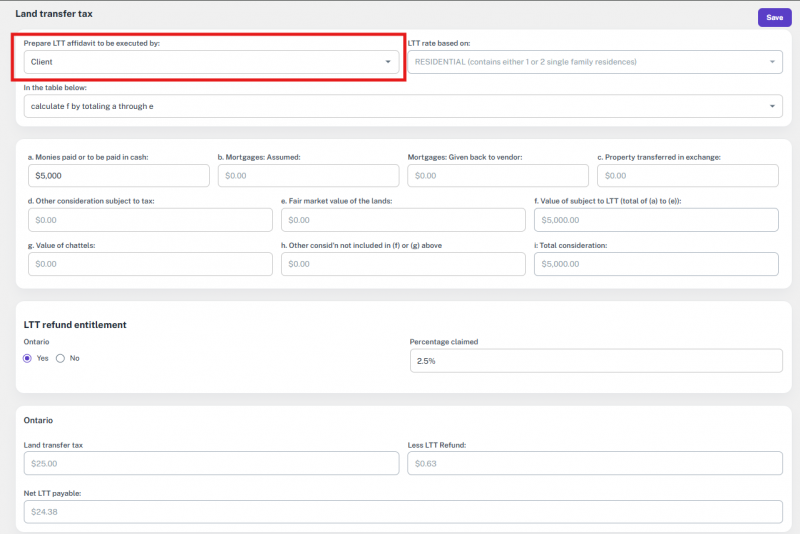
2 LTT Rate Based On
This field is pre-set to “RESIDENTIAL (contains either 1 or 2 single-family residences)” by default and cannot be changed by the user.
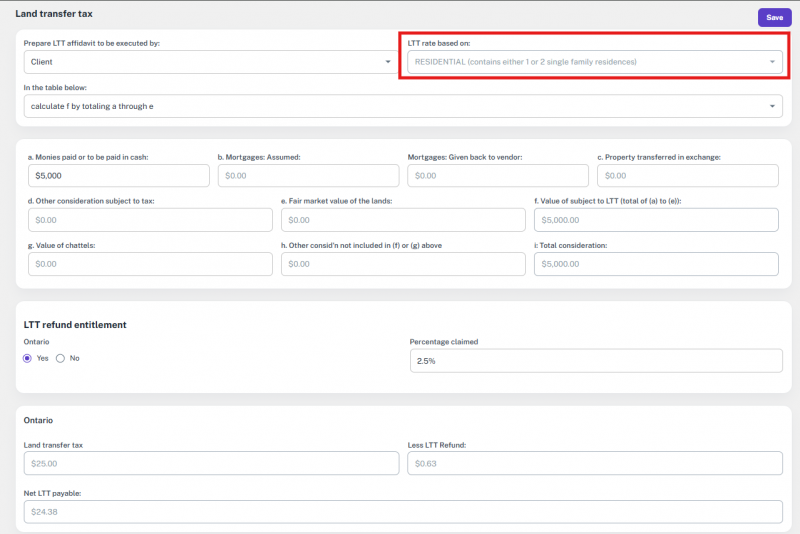
3 Consideration Table
This section is used to input all financial components that contribute to the total consideration of the property. Each field is described below:
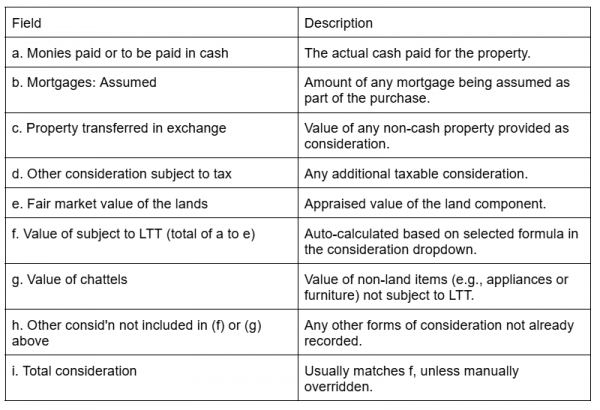
4 Consideration Details Table
This dropdown defines how the system calculates the value for field f (Value of subject to LTT) and field a (Monies paid or to be paid in cash). It determines the internal logic used for computing the Land Transfer Tax. The available options are:
- Calculate f by totaling a through e
- This option totals the values from fields a to e and assigns the result to field f.
- The amount in a equals the amount in f
- This option makes f equal to the value entered in a only, ignoring the other fields.
- Calculate a by subtracting b through e from f
- This reverses the logic: field a is automatically calculated by subtracting the values of b, c, d, and e from f.
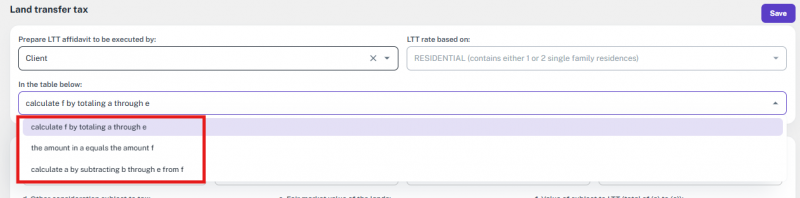

5 LTT Refund Entitlement
This section checks for eligibility for a Land Transfer Tax refund, specifically in Ontario.
- Select “Yes” or “No” for Ontario refund eligibility.
- Enter the Percentage Claimed (e.g., 2.5%).

6 LTT Summary – Ontario
This section provides the final tax calculation:
- Land Transfer Tax: Total tax computed based on the inputs and calculation method.
- Less LTT Refund: Amount eligible for refund (if applicable).
- Net LTT Payable: Final amount the client is liable to pay after adjustments.

12.3 Teraview Import
This guide will walk you through the process of importing mortgage information directly from a Teraview XML file. This feature automates data entry, saving time and ensuring accuracy.
12.3.1 Accessing the Export Function
To import a mortgage, you must first be on the “New mortgage tab”. Once there, locate the Teraview export icon in the top-right corner of the screen, next to the file details.
- Locate the Export Icon: This icon looks like a document with a download symbol, as highlighted in the images.
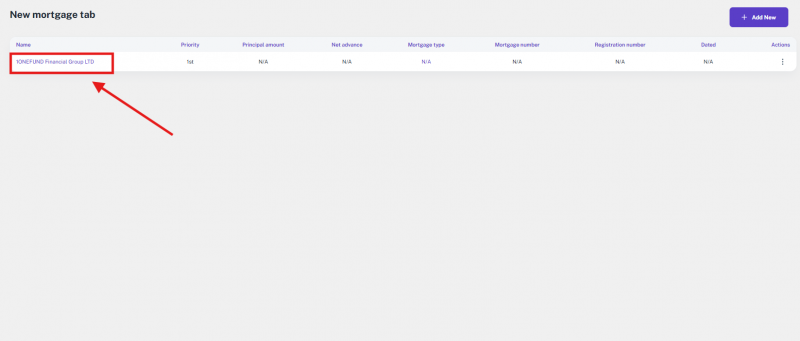
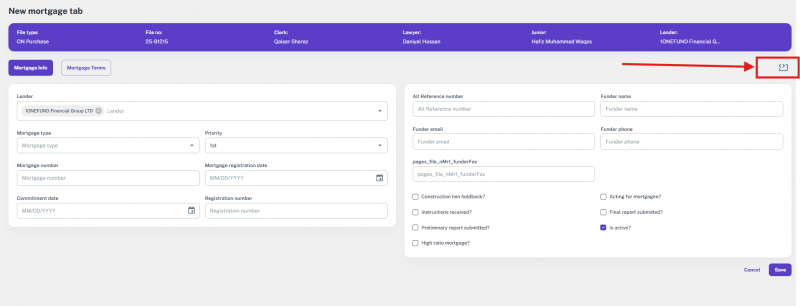
12.3.2 Generating the XML Data
Clicking this icon will generate the necessary XML data for your mortgage.
- URL Generation: The system will not prompt you for a file. Instead, it will generate a unique URL containing the XML data. A “Copied!” message will appear, confirming that this URL has been copied to your clipboard.
- Accessing the XML Code: Paste the copied URL into a new browser tab. This action will display the raw XML code, which contains all the mortgage information in the Teraview-compatible format.
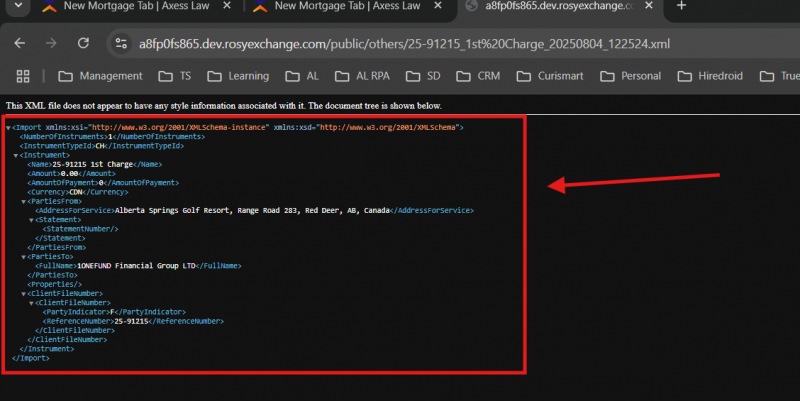
12.3.3 Importing into Teraview Portal
Once you have the XML code displayed in your browser:
- Copy the XML: Select and copy all of the XML code from the browser tab.
- Paste into Teraview: Go to the Teraview Portal and paste this copied XML code into the appropriate section to import and process the mortgage information.
This process allows you to quickly and accurately transfer mortgage details from our system to the Teraview Portal without manual data entry.
12.3.4 Teraview Export via Doc Submission
This guide explains how to use the “Doc Submission” feature to prepare and export mortgage information for the Teraview Portal. This process ensures all necessary data is complete before export, preventing errors in the Teraview system.
12.3.5 Accessing the Doc Submission Feature
Navigate to the “Doc Store” and select the “Doc Submission” tab. This is where you will manage and prepare the documents for external portals like Teraview.
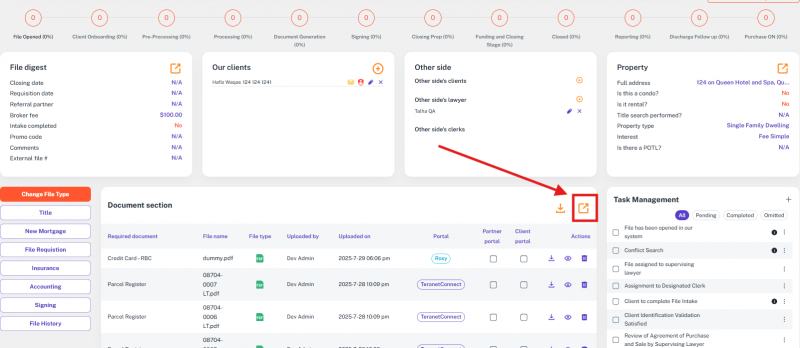
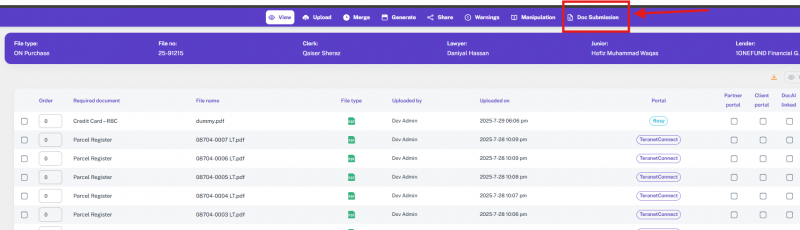

12.3.6 Exporting via XML View
This method is ideal for a quick copy-and-paste into the Teraview Portal.
- Validate Data: Before generating the XML, the system performs a validation check. If any required fields are missing, a list of these fields will be displayed as a red-highlighted alert. You must fill in all of the listed fields before you can proceed with the export.
- Generate and View XML: To begin, click the view icon (an eye symbol) in the “Actions” column next to the document you want to export. This action will open a pop-up window displaying the raw XML code.
- Copy and Paste: Select and copy the entire XML code from the pop-up window. Then, go to the Teraview Portal and paste the code into the appropriate section to import the data.

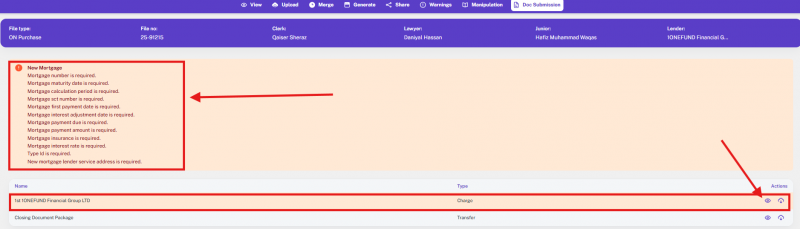
12.3.7 Exporting via XML Download
This method is useful if you prefer to work with a physical file.
- Validate Data: Similar to the view option, the system will first check for any missing required fields. If an alert appears, you must fill in the necessary information before you can download the file.
- Download XML File: To download the file, click the download icon (an arrow pointing down) in the “Actions” column next to the document. The system will download a Teraview-compatible XML file directly to your computer.
- Import to Teraview: Once the file is downloaded, you can import this XML file into the Teraview Portal to process the mortgage information.

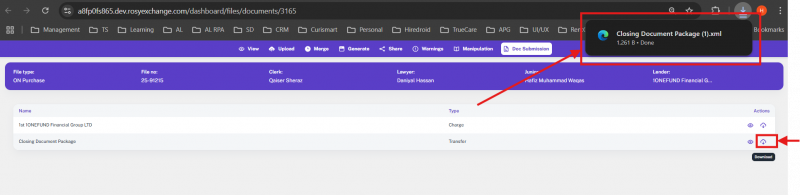
12.4 Doc Store
The Document Section is your central hub for all files and legal documents related to a specific case. Use this guide to navigate its features, ensuring your files are organized, accessible, and ready for collaboration.
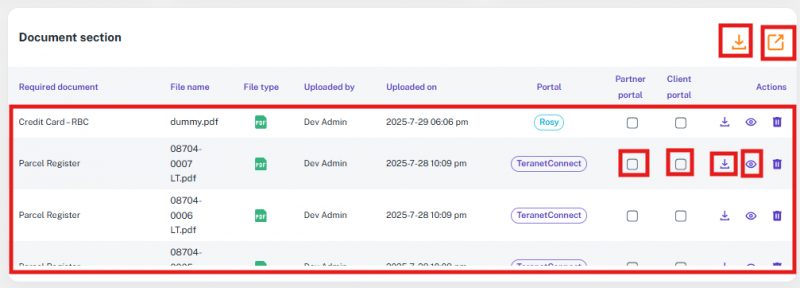
- In the attached image above, you can see the Doc Store section of a particular file.
- You can download all the documents by clicking the arrow in the header, which will provide a ZIP file containing all the documents.
- In this grid view, you will be able to see the details of your uploaded documents.
- You can share these documents with referrals and clients by selecting the checkboxes.
- You will be able to download or preview any specific document.
- You can expand the section to view additional features of our Doc Store.
12.4.1 Managing Your Documents
The main document list provides an overview of all files.
- By selecting multiple checkboxes, you can easily preview these documents in a single window.

- View: To view a document without downloading it, click the eye icon in the “Actions” column.
- Download: To save a single document to your computer, click the download icon in the “Actions” column. You can also download all documents at once by clicking the download icon at the top of the section.

- By clicking the book icon, you can manipulate the document using the available features in ROSY.
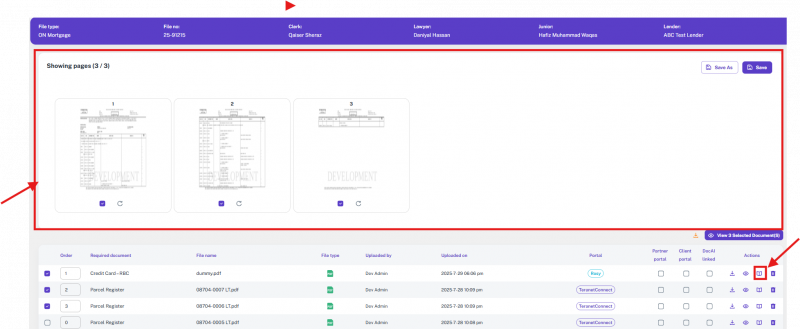
- Delete: To remove a document, click the trash can icon.
- Portal Links: Documents may be linked to external portals like ROSY or TeranetConnect. Clicking the portal name will open the document in the corresponding external system.
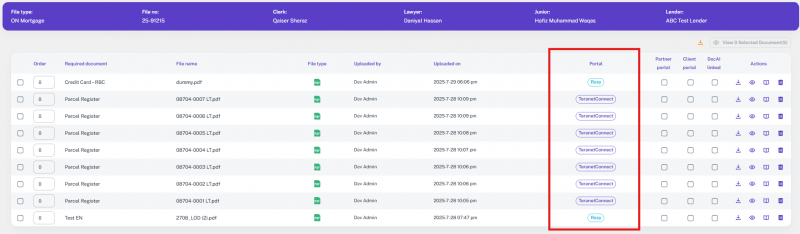
12.4.2 Uploading Documents
- To add a new document to this file, click the “Upload” button at the top of the screen.
- Select Document Type: Before uploading, choose the appropriate Document type from the dropdown menu. This categorizes the document within the system.
- Add Your File: You have two options to add the file:
- Drag and Drop: You can drag the file from your computer and drop it directly into the designated area.
- Browse: Alternatively, click the “browse through your machine” link to open a file selection dialog and choose the file you want to upload.
- Confirm Upload: After selecting your file, click the final “Upload” button to complete the process and add the document to the file.
12.4.3 Merging Documents
The “Merge” feature allows you to combine multiple PDF documents into a single, organized file. This is useful for creating consolidated packages or reports.
- Select Documents to Merge
- First, navigate to the Document Section and select the documents you wish to combine.
- Checkboxes: Click the checkbox next to each document you want to include in the merge.
- Name the New Document
- Document Type: Use the dropdown menu to select the appropriate type for the new document (e.g., “Property Tax Payment Receipts” as shown in the example).
- Document Name: Enter a descriptive name for the new file in the “Document name” field. This is how the new merged document will appear in your document list (e.g., “Latest Report”).
- Complete the Merge
- Once you have specified the document type and name, click the final “Merge” button within the pop-up window. The system will then combine your selected files into a single PDF and add it to your document list.
12.4.4 Generating Documents from Packages/Templates
The “Generate” function creates new documents using pre-configured templates.
- Click the “Generate” button.
- In the left pane, you can select a Package or choose individual templates from Axess Documents or Lender Documents.
- The “Selection” area will display the templates you've chosen.
- Drag and drop the selected item(s) to change their sequence as well.
- In the Generate section at the bottom, name your new document and select the Document type from the dropdown.
- If you select a package, the document name and type will default to the package name. If you do not select a package, the name of your first template will be used as the default document name and type.
- Choose your desired format: Word or PDF.
- If you try to generate a combination of Word and HTML templates, the output will only be generated as a PDF.
- However, in the case of multiple DOCX selections, you will have the option to generate the documents in either DOCX or PDF format.
- In the case of a PDF, the user will be able to preview the document online.
- In the case of a DOCX, the user will not be able to preview the document online; it must be downloaded first to view it.
- Click “Preview” to review the document before creating it, or click “Save As” to generate and save the final file.
12.4.5 Sharing Documents
To send documents to others, use the “Share” feature.
- Select the documents you want to share by checking the boxes next to their names.
- Click the “Share” button.
- In the pop-up window, select the recipients you want to send the documents to.
- Write a brief message if needed.
- The selected documents will be listed as attachments.
- Click “Send” to email the documents to your recipients.
12.4.6 Document Manipulation
Accessing the Manipulation Tool:
- Navigate to the main document list.
- Click the “Manipulation” button in the top navigation bar.
- Select the document you wish to edit from the list.
Editing Pages:
To begin manipulating a document, you must first select it.
- Accessing Manipulation: Click the book icon in the “Actions” column next to the document you wish to edit. This will open the manipulation tool, showing a thumbnail view of all pages.
- Rotate Pages: To rotate a page, click the circular arrow icon on the page thumbnail. Each click rotates the page by 90 degrees.
- Reorder Pages: To change the order of pages, drag and drop a page thumbnail to its desired position.
- Delete Pages: To delete a page, uncheck the box located on the page thumbnail. Any pages that are unchecked will be removed from the document when you save your changes.
Saving Your Changes:
Once you have made all your edits, you have two options for saving:
- Save: Click the “Save” button at the top of the screen to apply all changes directly to the original document. This will overwrite the existing file.
- Save As: Click the “Save As” button to create a new document with your changes. This is useful for keeping the original document intact. A pop-up window will appear where you can specify the Document type and Document name for the new file. After entering the details, click “Save” to add the new, manipulated document to your file list.
12.4.7 Document Warning
The “Warnings” section, also known as the Document Portal Access Manager, gives you granular control over which documents are visible to your clients and brokers. This ensures that sensitive information is only shared with the appropriate parties.
Accessing the Document Warning Section:
Click the “Warnings” button in the top navigation bar. This will take you to a table that lists all possible document types.
Managing Document Visibility:
The main table shows you every document type and its current visibility settings for external portals.
- “Show in Broker Portal” Column: Use the checkboxes in this column to control which document types are visible to your brokers.
- Check the box to make the document type visible in the broker portal.
- Uncheck the box to hide the document type from the broker portal.
- “Show in Client Portal” Column: Use the checkboxes in this column to control which document types are visible to your clients.
- Check the box to make the document type visible in the client portal.
- Uncheck the box to hide the document type from the client portal.
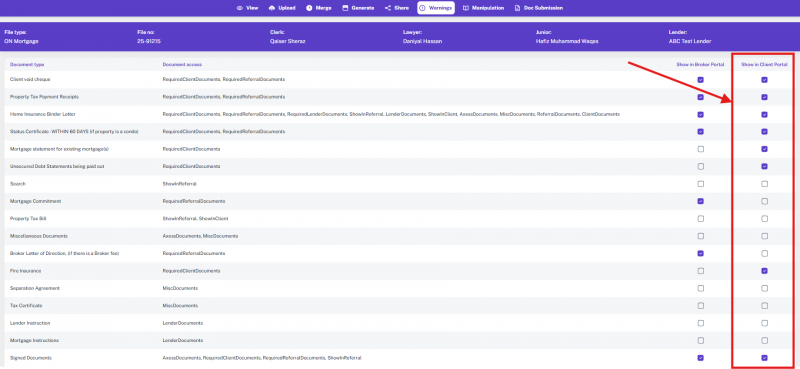
13. Signing
13.1 Interface
The Signing Module helps clients and signing agents perform document signings in a secure and compliant way. You can perform signings through:
- In-Person
- Concurrent (online signing)
- Virtual Video Conference (Online Meeting)
This guide explains how to access the Signing Module, view signings, and manage different signing types.
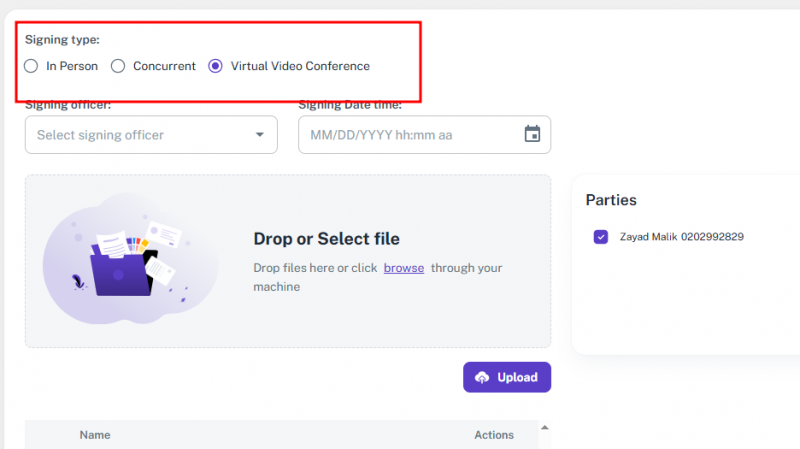
Method 1: Accessing the Signing Module
Step 1 – Open the Signing Menu
- Go to the top menu bar.
- Hover over Signing.
Step 2 – Choose a Section
- My Signings – View all signing requests assigned to you as a signing agent
- Manage Signings – Add or edit signings.
- Missed Signings – Track signings that were not completed.
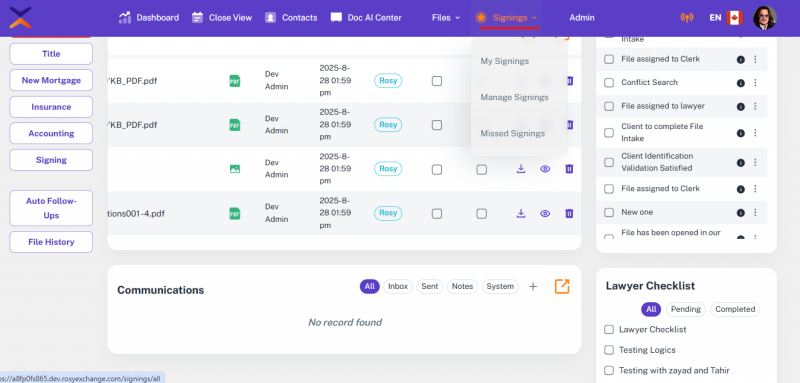
Method 2: My Signings
Step 1 – View Assigned Signings
- Open My Signings to see your list.
Step 2 – Review Details
The table includes:
- File No.
- Parties
- Clerk
- Signing Agent
- Date & Time
- Signing Type (In-person, Virtual, etc.)
- Status (Scheduled, Completed, Pending)
- Manage options
Method 3: Manage Signings
Step 1 – Open Manage Signings
- Go to Manage Signings in the menu.
Step 2 – Select an Action
- View signing details.
- Edit or update information.
- Add a new signing type when needed.
Method 4: Missed Signings
Step 1 – Open Missed Signings
- Select Missed Signings from the menu.
Step 2 – Review Missed Entries
The table includes:
- File No.
- Parties
- Clerk
- Signing Agent
- Date & Time
- Signing Type
- Status
- Manage (View or Reschedule)
Method 5: File Signing Tab
Step 1 – Open the File Signing Tab
- Go to the specific file and click the Signing Tab.
Step 2 – Review File Details Ribbon
You will see:
- File Type, File No., Clerk, Lawyer, Junior, Lender.
Step 3 – Review Signing Entries
Each entry shows:
- Signing Type
- Signing Agent
- Date & Time
- VSR Link (for Virtual Signings)
- Package in Syngrafii
- Drafted / Completed status
- Manage options (Edit, Message, Cancel)
Method 6: Adding a New Signing
Option A – In-Person Signing
- Step 1 – Select a Signing Officer
- Step 2 – Choose Date & Time
- Step 3 – Add Comments if needed
- Step 4 – Save or Cancel
- Rule: Only one signing can be active at a time.
Option B – Concurrent Signing
- Step 1 – Select Sign By Date/Time
- Step 2 – Upload Files
- Step 3 – Choose Parties to Sign
- Step 4 – Add Comments
- Step 5 – Save & Send to Parties
Functional Flow:
- Sent to Syngrafii for management.
- Select signers and finalize the package.
- Clients receive email invitations.
- Once signed → Status updates to Completed
Option C – Virtual Video Conference Signing
- Step 1 – Select a Signing Officer
- Step 2 – Choose Date & Time
- Step 3 – Upload Files
- Step 4 – Select Parties
- Step 5 – Add Comments
- Step 6 – Choose Action:
- Cancel Signing
- Save as Draft
- Edit Package in Syngrafii
- Save & Send Invitations
Functional Flow:
- Clients receive an email invitation with the date, time, and conference link.
- During the call, all parties review & sign.
- Once complete, → Status updates to Completed.
Method 7: Client Portal – Signature Appointment
When a client is selected for signing, the details also appear inside the Client Portal under the Signature Appointment section.
From here, clients can directly view their signing type and take action accordingly.
Step 1 – Client Login
- Client logs in to the Client Portal.
Step 2 – Open Signature Appointment
- Navigate to the Signature Appointment section.
- The system shows signing details based on the Signing Type.
Step 3 – Signing Actions by Type
- In-Person Signing
- Client sees the Scheduled Date & Time.
- No meeting link is provided (signing will be done physically with the Signing Officer).
- Concurrent Signing
- Client sees the Signing Document(s) listed.
- By clicking the document, the client can directly review and sign online.
- Virtual Video Conference Signing
- Client sees the Meeting Link with the scheduled Date & Time.
- By clicking the link, the client joins the virtual meeting, reviews documents, and signs them during the session.


Step 4 – Status Update
- Once the signing is completed, the system updates the status to Completed in both:
- Rosy Signing Module
- Client’s Portal
13.2 Functionality
The Signing feature ensures that clients sign all required documents through different signing methods (In-Person, Concurrent, or Virtual Video Conference). This process helps maintain legal compliance and provides a complete audit trail of signatures.
Key Functional Impacts
1. Controlled Signing Flow
- A new signing can only be created after the previous signing is either completed or canceled.
- This prevents duplication and ensures the signing process remains sequential and accurate.
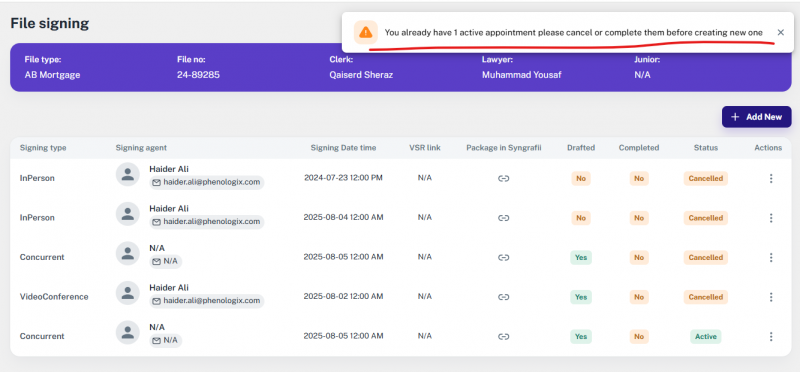
2. Flexible Signing Options
- Users can choose the appropriate signing type based on the situation:
- In-Person – physical signing managed by a signing officer.
- Concurrent – multiple parties sign documents online within a set date.
- Virtual Video Conference – parties join a video call to review and sign together.
3. Automated Notifications & Tracking
- Clients receive email invitations with signing details (date, time, and links).
- Once documents are signed, the system updates the status to Completed automatically.
- This provides real-time visibility of signing progress.
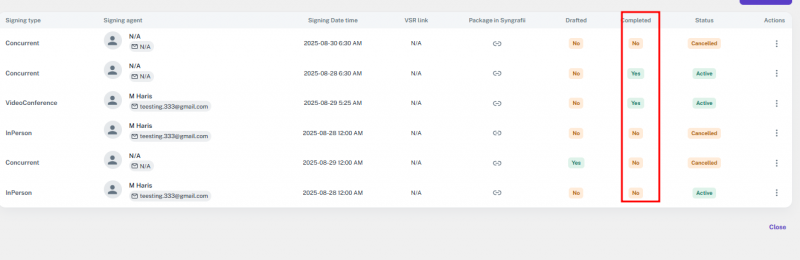
4. Integration with Syngrafii
- For Concurrent and Virtual signings, Signings are managed through Syngrafii.
- Users can upload documents, add signers, edit packages, or save drafts before sending.
- Ensures compliance and flexibility when handling digital signings.
5. Audit & Compliance
- All signing records (file number, parties, officer, date/time, type, and status) are stored in the system.
- Provides a complete audit trail for verification and compliance.
6. Signing in to task management
- Signing Package: When at least one document is uploaded against a signing package document tag.
- Appointment Set: When a Video Conference Signing is scheduled.
- Two Tasks: The signing takes place, and the signed document is uploaded. This happens only when Syngrafii returns the signed documents to the system.
- Manual Appointment: If a signing appointment is manually marked as true but no signing is actually created (i.e., no date and time are set in the signing appointment), then it will not be considered true.
14. Admin
14.1 Audit Log
The Audit Log module tracks every action in the system by all user roles — Admins, Clients, Referrals, and Lenders. It helps maintain transparency, makes debugging easier, and monitors system performance.
Key Features
- View real-time activity logs for all users and system operations.
- Search logs by Method Name.
- Filter logs by Date Range, Log Type, or User.
- Export logs to CSV or Excel format.
- Monitor execution times, exceptions, and performance issues.
Method 1 – Access the Audit Log
Step 1 – Open the Admin Panel
- Go to the Admin Panel in your application.
- From the left-hand menu, click Audit Log.
- The Audit Log page will open, showing a table of all recorded logs.
Method 2 – Understanding the Page Layout
Step 1 – Header Area
- Top Left: Displays the section title “Audit Log”.
- Breadcrumb Navigation: Shows your location: Admin > Audit Log.
- Top Right:
- Search Field – Search logs by Method Name.
- Export Button – Download the log table as CSV or Excel.
Method 3 – Using Filters
Filters help you narrow down logs for review.
Available Filters:
- Date Range – Select start and end dates.
- Log Type – Choose:
- New
- Info
- Error
- User Filter – Search and select a specific user.
- Actions:
- Set Filter – Apply selected filters to update the table.
- Reset Filter – Clear all filters and return to the default view.
Method 4 – Understanding the Logs Table
The Logs table lists all tracked actions in detail.
Table Columns:
- User Name – Who acted.
- Service Name – Which section or module was used?
- Method Name – The specific method or function executed.
- Parameters – Input data used in the action.
- Log Type – New, Info, or Error.
- Exception Message – Error details (if any).
- Execution Time & Date – Exact time and date of execution.
- Duration – Time taken to execute (ms or s).
14.2 Brokerage
The Brokerage Section lets administrators create and manage brokerage records used across the platform—especially for referrals and file filtering.
Once a brokerage is added, it becomes available for selection in different modules, ensuring consistency and centralized control.
14.2.1 Interface
Method 1 – Accessing the Brokerage Section
Step 1 – Go to the Admin Panel
- Open the Admin Panel from the main navigation.
- In the left-hand menu, click “Brokerage.”
- The Brokerage page will open.
Method 2 – Searching and Adding a Broker
Step 1 – Search for an Existing Broker
- At the top of the page, type the broker’s name in the search bar.
Step 2 – Add a New Broker
- Click the Add Broker button next to the search bar.
- The Add Broker Form will appear.
Method 3 – Using Filters
Step 1 – Open the Filter Panel
- Click the Filter icon under the Add Broker button.
- The filter panel will slide open.
Step 2 – Apply or Reset Filters
- Set a Date Range or other filter criteria.
- Click Set Filter to apply filters.
- Click Reset Filter to clear and reload all results.
Method 4 – Understanding the Brokerage Table
The Brokerage table displays the following columns:
- Name – Click to edit the brokerage.
- Parent Company – The company the brokerage belongs to.
- Operating Brand – The brand name used.
- Type – The brokerage category.
- Created By – User who added the record.
- Updated By – User who last edited the record.
- Date Created – When it was first added.
- Date Updated – Last edit date.
- Status – Active or Inactive.
- Action Button – Click to open edit options.
Method 5 – Adding a New Brokerage
Step 1 – Open the Add Broker Form
- Click Add Broker on the Brokerage page.
Step 2 – Fill in the Required Fields
Required:
- Name
Optional but Recommended:
- Parent Company (dropdown)
- Operating Brand (dropdown)
- Phone Number
- EXT
- Brokerage Type (dropdown)
- Account Owner User (dropdown)
- Principal Broker (dropdown)
- License Number
- Billing Address, Street Name, City, Province (dropdown), Postal Code
- Description
- Is Active (checkbox)
Step 3 – Save or Cancel
- Click Create to save the record.
- Click Cancel to discard changes.
Method 6 – Editing an Existing Brokerage
Step 1 – Open the Edit Form
- Either click directly on the Brokerage Name in the table, OR click the three-dot Action Button and select Edit.
Step 2 – Update Details
- The form will open pre-filled with the existing data.
- Make the necessary changes and save.
14.2.2 Functionality
Managing Brokerage During Referral Creation and Filtering Files
This guide explains how to select a brokerage when creating a referral and how to filter files by brokerage in the Files section.
Brokerages are linked across different fields in the referral form, similar to a parent–child relationship.
Part 1 – Selecting Brokerage in Referral Creation
Use these steps when adding a new referral.
Step 1 – Open the Referral Form
- Navigate to the Referrals section from the Admin Menu.
- Click Add New Referral.
Step 2 – Select Brokerage Information (First Card of Form)
There are three interconnected brokerage fields:
- Brokerage Field – Select the brokerage created earlier.
- Parent Company Field – Select the parent company (brokerage).
- Operating Brand Field – Select the brand name (brokerage).
These fields update each other automatically based on your selections, just like parent–child linked dropdowns.
Part 2 – Filtering Files by Brokerage
Use these steps to display only files linked to a specific brokerage.
Step 1 – Go to the Files Tab
- Navigate to the Files section.
Step 2 – Open the Filter Panel
- Click the Filter button to expand the panel.
Step 3 – Apply Brokerage Filter
- Find the Brokerage dropdown.
- Select the desired brokerage from the list.
- Click Apply Filter.
The system will now display only files associated with that brokerage.
14.3 Debt Statements
This guide explains how to view, search, and add debt statement records in the system.
Debt statements are predefined debt records that can be used later in Statements of Account and Trust Ledger under file details.
They help keep debt-related entries consistent and accurate across the platform.
14.3.1 Interface
Method 1 – Open the Debt Statements Section
Step 1 – Go to the Admin Tab
- Click the Admin tab in the top navigation bar.
Step 2 – Select Debt Statements
- The left-side menu will appear.
- Click Debt Statements from the list.
- You will now be on the Debt Statements management page.
Method 2 – Search and Add Debt Records
Step 1 – Search for a Record
- Use the Search bar at the top to find existing debt statements by Name.
Step 2 – Open the Add Debt Form
- Click the Add Debt button next to the search bar.
- The Add New Debt form will open.
Method 3 – Understanding the Debt Table
The table on this page lists all debt statements with these details:
- Name – Name of the debt record.
- Filter Type – Category or type of the debt.
- Province – The province where the debt applies.
- Status – Whether the debt is Active or Inactive.
- Action Button – Allows you to edit a record.
Tip: You can click the Name or the Action Button to edit any record.
Method 4 – Add a New Debt Statement
Step 1 – Open the Form
- Click the Add Debt button.
Step 2 – Fill in the Details
- Name: Enter the debt name (e.g., Payable to Bank) — Required field.
- Transaction Type: Select from the dropdown (e.g., Credit, Debit).
- Province: Select the applicable province.
- Status: Check the box to mark as Active, or leave unchecked to keep as Inactive.
Step 3 – Save or Cancel
- Click Add to save the record.
- Click Cancel to close without saving.
14.3.2 Functionality
Using Debt Statements in the Platform
This guide explains where and how to use Debt Statements within the File Details page. Using predefined Debt Statements ensures accuracy and consistency in account transactions.
Method 1: Add in the “Statements of Account” Section
Use this method when you want to link a Debt Statement directly to the file’s Statements of Account.
Step 1 – Open the Accounts Tab
- Open the file you’re working on.
- Click the Accounts tab.
Step 2 – Go to Statements of Account
- Under Statements of Account, click Add New Entry.
Step 3 – Select a Debt Statement
- In the entry form, find the Debt Statements dropdown.
- Choose the relevant predefined Debt Statement.
Method 2: Add in the “Trust Ledger” Section
Use this method when you want to record a Debt Statement in the Trust Ledger.
Step 1 – Open the Accounts Tab
- Open the same file and click the Accounts tab.
Step 2 – Go to the Trust Ledger
- Under Trust Ledger, click Add New Entry.
Step 3 – Select a Debt Statement
- In the entry form, find the Debt Statements dropdown.
- Choose the relevant predefined Debt Statement.
14.4 Designations
This guide explains how to create and manage designations within the system.
Designations are job titles or position labels (e.g., Mortgage Agent, Regional Manager, Broker) used in the Referrals module.
They are not linked to internal user roles (like Law Clerk, Lawyer, Admin) and do not control system permissions or access.
14.4.1 Interface
Step 1 – Open the Designations Section
- From the top header menu, click the Admin tab.
- A left-side panel will appear.
- In the panel, select Designations to open the module.
Step 2 – View the Designations Page:
- Name Column – Shows the list of existing designations (e.g., Mortgage Agent, Assistant Manager).
- The Designations page displays all job titles or position labels used in referrals.
- Actions Column – Allows editing of existing designation names. (No delete option is available.)
Step 3 – Add a New Designation
- Click the Add New Designation button.
- A form will appear—enter the new designation name.
- Save your changes to update the list.
14.4.2 Functionality
Functional Effect on User – Designations
The Designations module allows administrators to create and manage official title labels (e.g., Mortgage Agent, Broker, Manager) used exclusively in the Referrals module.
How It Works
* Adding a Designation
- When an admin adds a new designation on the Designations page, it is automatically added to the Designation dropdown in the Referrals form.
* Where It Appears
- The dropdown is used in both the Primary Information section and the Associate section when creating or editing a referral.
* Benefits
- Ensures consistent labeling of referral contact titles across the platform.
- Speeds up data entry and reduces the chance of manual errors when creating or updating referrals.
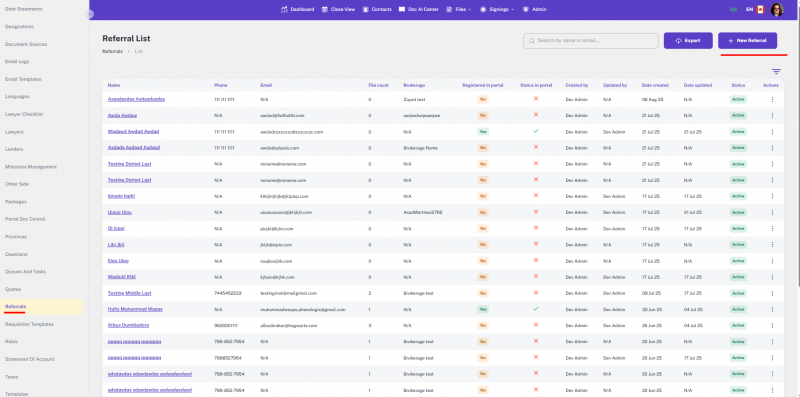
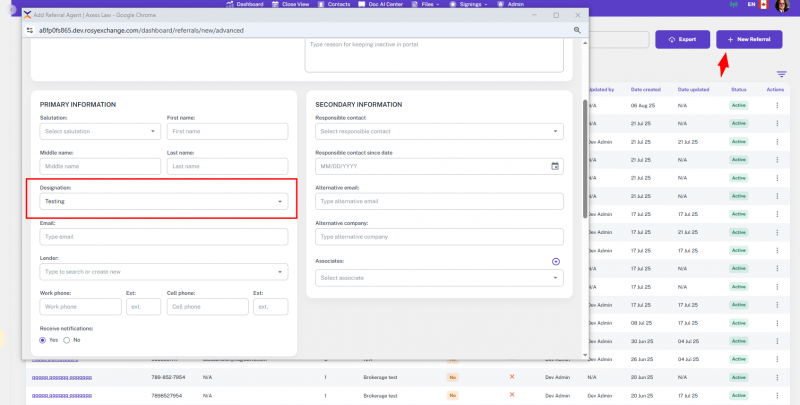
14.5 Document Sources
This guide will help you add, edit, and filter document sources in the system.
Document sources define the origin or type of documents used across the platform. Once added, they become available in other areas, such as the Templates module.
14.5.1 Interface
Method 1 – Adding a New Document Source
Step 1 – Open the Document Sources Section
- Click the Admin tab from the top header menu.
- In the left navigation panel, select Document Sources.
- The main page will display a list of existing document sources.
Step 2 – Add a New Source
- Click the Add New Source button (top-right of the page).
- In the form that appears:
- Enter the Document Source Name.
- Check or uncheck the Active box to set the status.
Step 3 – Save the New Source
- Click Add to save the entry.
- Click Cancel to close the form without saving.

Method 2 – Editing an Existing Document Source
Step 1 – Find the Source to Edit
- In the main table, locate the document source you want to update.
Step 2 – Open the Edit Form
- In the Actions column, click the Edit button.
Step 3 – Make Changes
- Update the Document Source Name as needed.
- Adjust the Active status if necessary.
Step 4 – Save Updates
- Click Save to apply changes.
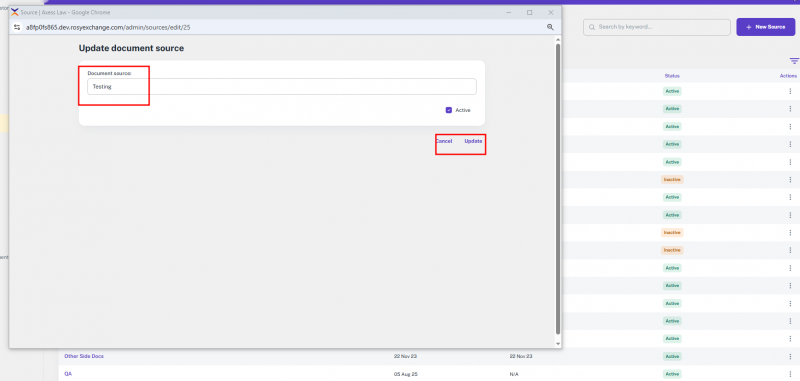
Method 3 – Filtering Document Sources
Step 1 – Open Filters
- In the Document Sources section, locate the filter panel.
Step 2 – Set Date Filters
- Select Created Date – Start Date.
- Select Created Date – End Date.
Step 3 – Apply Filter
- The table will update to show only document sources created in the selected date range.
14.5.2 Functionality
Template Integration
- Any new document source automatically appears in the Source dropdown when adding a new template in the Templates module.
- Helps in tagging and organizing templates based on document origin.
Document Store Usage
- In the Doc Store → All Files → Details view:
- Open the Document section and click Detail View.
- Click Generate, which is at the top it will open a page where you can select both Axess Documents and Lender Documents.
- Ensures consistency and accuracy in document management workflows.
14.6 Email Logs
The Email Logs section lets administrators review failed email attempts within the system.
It provides detailed information about undelivered emails, helping admins quickly investigate and resolve delivery issues—improving communication reliability and system accountability.
14.6.1 Interface
Step 1 – Open the Email Logs Section
- From the top header menu, click the Admin tab.
- A left-side panel will appear.
- Select Email Logs to open the page.
Step 2 – Understand the Email Logs Table
The table contains the following columns:
- Subject – The email’s subject line.
- From – The sender’s email address.
- TOs – Recipients listed in the “To” field.
- CCs – Recipients listed in the “CC” field.
- BCCs – Recipients listed in the “BCC” field.
- Response – The system’s feedback after trying to send the email.
- Status – Shows the delivery status (this section only lists failed emails).
- Dated – The date and time the email was attempted.
- Action – A View button to see detailed information about the email.
Step 3 – Filter Email Logs
- Use the Start Date and End Date filters to display only logs within a specific period.
- This helps narrow results and focus on relevant failed email attempts.
14.6.2 Functionality
The Email Logs feature gives administrators real-time visibility into failed email deliveries.
How It Helps:
* Focused Monitoring
- Only failed emails are listed, allowing users to quickly identify and address communication issues caused by technical errors or incorrect recipient details.
* Detailed Troubleshooting
- The View action provides full details of each failed email, making it easier to diagnose and resolve problems.
* Improved Communication Reliability
- Proactive monitoring ensures system-generated emails reach their intended recipients, enhancing both reliability and accountability in communication.
14.7 Email Templates
The Email Templates module lets administrators create, manage, and configure pre-written email templates.
These templates are used across the system for automated or manual communication with users, clients, lenders, and other stakeholders.
14.7.1 Interface
Method 1 – Accessing the Email Templates Section
Use this method if you want to view, search, or create templates.
Step 1 – Open the Admin Tab
- Click the Admin tab in the top navigation bar.
- A left-side panel will open.
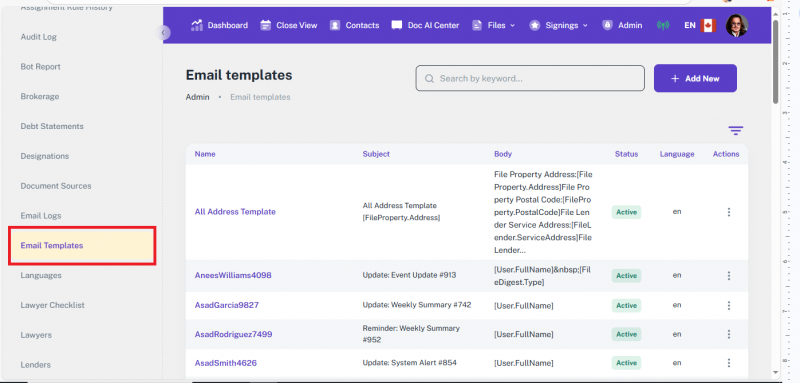
Step 2 – Go to Email Templates
- In the left panel, click Email Templates.
- You will be taken to the Email Templates section.
Method 2 – Understanding the Section Layout
Header Area
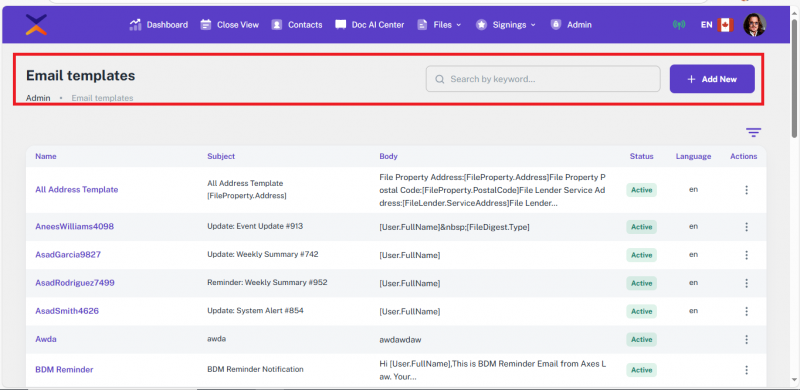
- Top-Left: Page title: Email Templates
- Breadcrumb: Admin > Email Templates
- Top-Right:
- Search Field – Type a template name to search.
- Add New Template – Click to create a new template.
- Filters Panel
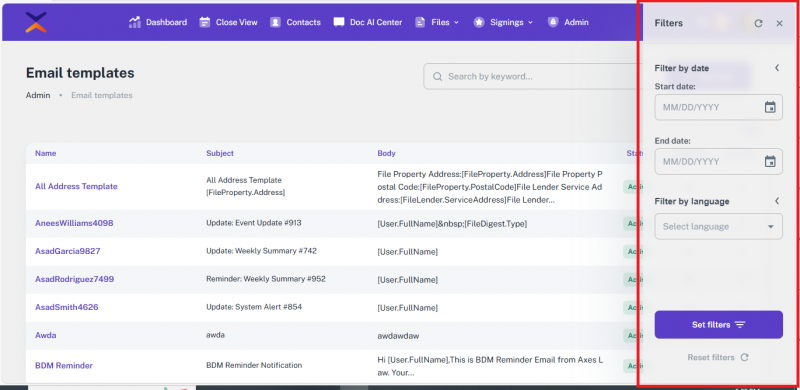
- Click the Filter icon below the “Add New Template” button to open filter options.
- Top Buttons:
- Reset – Clear all filters.
- Close Filters – Hide the filter panel.
- Available Filters:
- Date range (From Date, To Date)
- Language/Province: EN (English) or FR (French)
- Bottom Buttons:
- Set Filter – Apply filters.
- Reset Filter – Clear all and reset the list.
Method 3 – Viewing the Email Templates Table
Table Columns
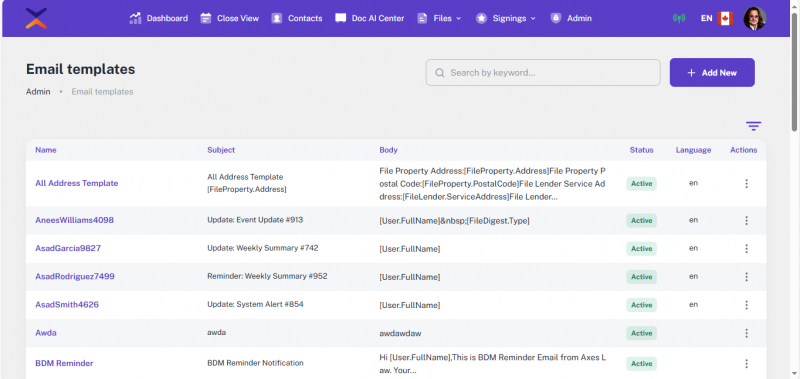
- Template Name – Click to open template for editing.
- Subject – Shows the email’s subject line.
- Body – Shows a preview of the email content.
- Status – Active or Inactive.
- Language – EN or FR.
- Action – Three-dot menu with:
- Edit – Open in edit mode.
- View – Open a read-only preview
- Pagination
- Navigate between pages.
- Rows per page: 25, 50, 75, 100.
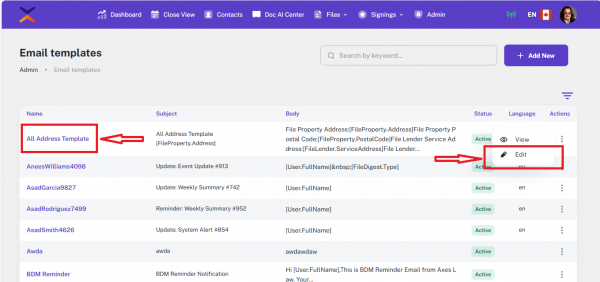
Method 4 – Creating a New Email Template
Step 1 – Click Create New
- In the Email Templates section, click Create New.
- The “Create New Email Template” form will appear.
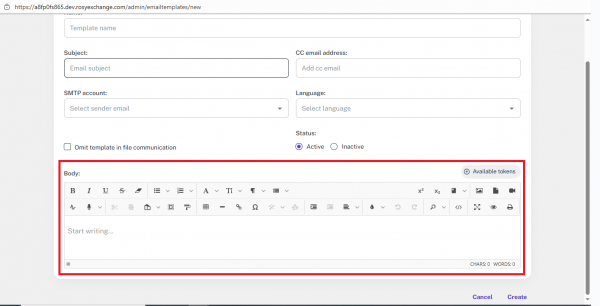
Step 2 – Fill Out the Form
- Template Name (required) – Enter the template name.
- Subject (required) – Enter the subject line.
- CC Email Address – Enter one or more CC addresses.
- SMTP Account – Select from the existing SMTP configurations.
- Language – Select EN or FR.
- Omit Template in File Communication – Tick if this template should not be used in file communications.
- Status – Select Active or Inactive.
- Email Body (required) – Write your message in the rich text editor:
- Supports bold, italic, and underline
- Fonts, sizes, colors
- Images, videos, audio files
Step 3 – Use Available Tokens
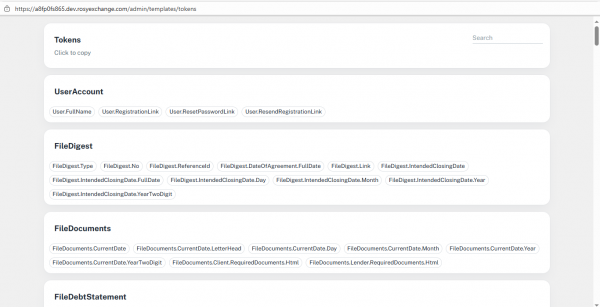
- Locate the Available Tokens Button
- The Available Tokens button is displayed above the body section on the right side.
- Open the Tokens Page
- Click the Available Tokens button.
- A page will open listing all available tokens.
- Search for Tokens
- Use the search bar on the tokens page to quickly find the token you need.
- Copy a Token
- Click on any token from the list.
- The selected token will automatically be copied.
- Insert Multiple Tokens
- Paste the token into the template body.
- You can repeat this process to insert multiple tokens as required.
Step 4 – Save or Cancel
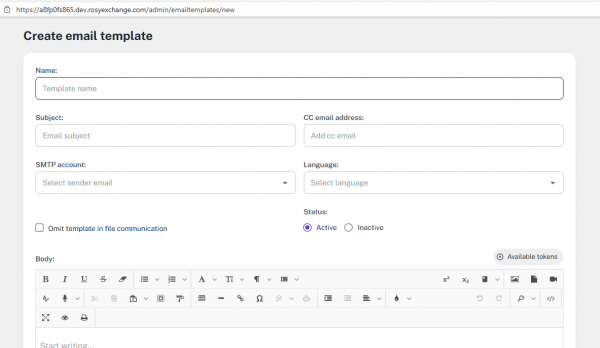
- Create – Save the new template.
- Cancel – Discard changes and return to the list.
Method 5 – Editing an Existing Template
- Option 1: Click the Template Name in the table.
- Option 2: Click the Action Menu (three dots) → Edit.
- The form opens pre-filled. Update the details and save.
14.7.2 Functionality
This guide explains how to use Admin-created email templates for sending messages and automating workflows. Templates help save time by pre-filling subject and body content, reducing typing and errors.
Method 1: Send an Email Using a Template (Communication Section – User Side)
Use this method if you want to send an email directly from a file’s Communication section.
Step 1 – Open File Details
- Go to the File section.
- Open the required file detail.
- Scroll down to the Communication section.
Step 2 – Add a New Email
- Click the Add New Communication button.
- Choose Email (instead of “Note”).
Step 3 – Select Recipient and Template
- In the Create Email form, select the recipient.
- After selecting the recipient, the Email Template dropdown will appear.
- Choose a template from the dropdown.
- The Subject and Body fields will be auto-filled based on the selected template.
Step 4 – Edit and Send
- Make any necessary changes to the email content.
- Click Send to deliver the email.
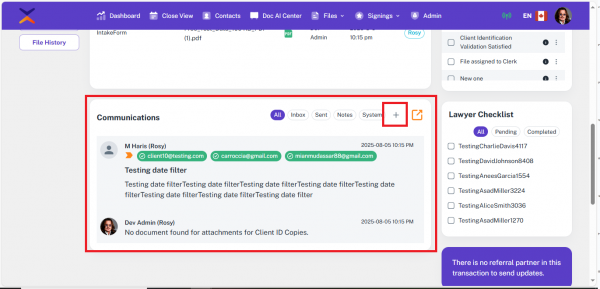
Method 2: Use Email Templates in Triggers (Automation – Admin Side)
Templates can also be linked to automated workflows through the Trigger feature.
1. Trigger Creation
- Go to the Trigger tab in Admin.
- Click the Add New button to create a trigger, or use the Menu button to edit an existing trigger.
- When creating a trigger, select an Email Template from the dropdown.
- When the trigger conditions are met in a file, the system automatically sends the email using the selected template.
- The email is sent to:
- The assigned user (based on the task or trigger)
- Any addresses in the TO, CC, and BCC fields
- Any custom BCC email addresses set in the trigger setup
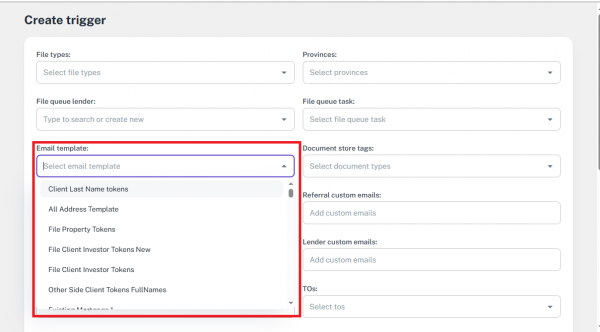
2. Trigger Linked to File Tasks
- If a trigger is assigned to a task:
- When the task is completed, the trigger activates.
- The system sends the email automatically using the chosen template.
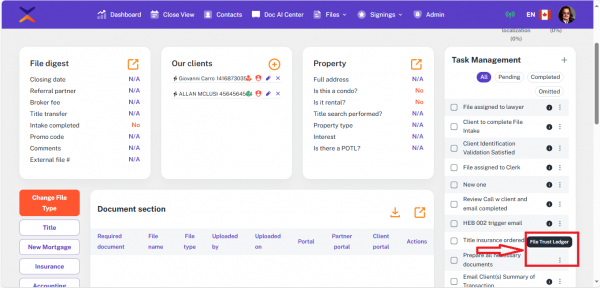
3. Trigger Rules with Templates
- While configuring Trigger Rules, admins can select an Email Template.
- This template defines the content of the email sent when the rule’s conditions are met.
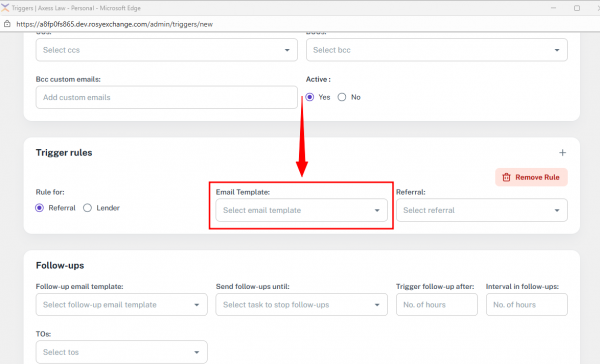
4. Follow-Up Triggers
- If a Follow-Up includes a trigger, selecting an email template is mandatory.
- Once the follow-up condition is fulfilled, the system automatically sends the associated email.
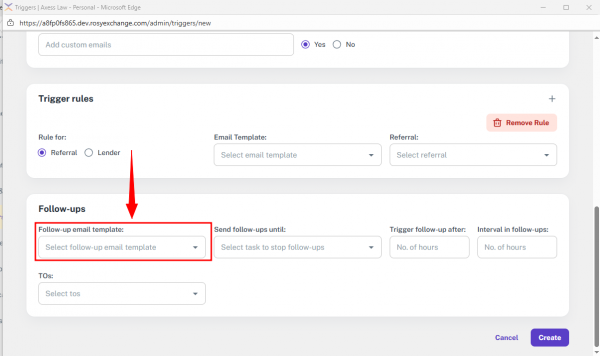
Method 3: Use Email Templates in Follow-Ups (Admin Side)
Email Templates can also be linked directly when creating or updating Follow-Ups in the Admin panel.
1. Access Follow-Up Section
- Go to the Admin tab.
- Select Follow-Up from the left-side menu.
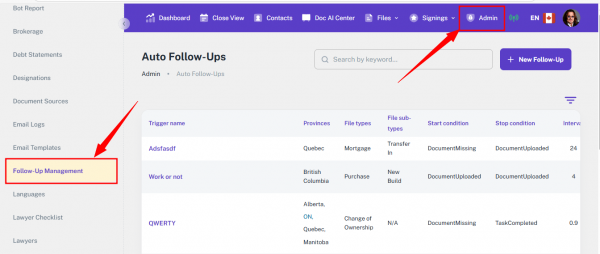
2. Create or Update a Follow-Up
- Click the Add New button to create a follow-up, or use the Edit option to update an existing one.
3. Define Follow-Up Roles → Recipients
- In the Recipients section, select the relevant checkboxes:
- Client
- Referral
- Lawyer
- Law Clerk
- External Contact
4. Select Email Template
- After choosing the recipients, select an Email Template from the dropdown list.
- The chosen template will be used as the email content for the follow-up.
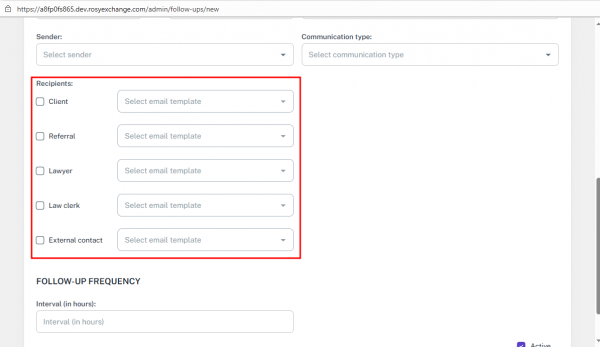
5. Follow-Up Execution
- Once the follow-up condition is met, the system will automatically send the email to the selected recipients using the assigned template.
14.8 Languages
The Language section allows administrators to manage system translations for English (EN) and French (FR). From here, admins can edit existing translations, add new ones, and filter entries by language.
This centralized management supports seamless bilingual functionality, improving localization and enhancing the user experience for multilingual teams.
14.8.1 Interface
Step 1 – Open the Language Section
- From the top header menu, click the Admin tab.
- A left-side panel will appear.
- Select Language to open the section.
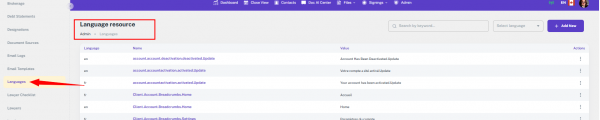
Step 2 – View the Language Table
- The Language table contains:
- Language – Displays the code (e.g., EN, FR).
- Name – The resource key (e.g., account.account.deactivation.deactivated).
- Value – The translation text (e.g., Account Has Been Deactivated. Update).
- Actions – Edit option to modify an existing value.
A Select Language dropdown is also available to filter the table by the chosen language.
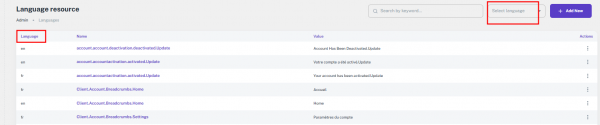
Step 3 – Add a New Translation Entry
- Click Add New to open the translation form.
- Fill in:
- Language Selection – Choose EN or FR.
- Resource Name – Enter the resource key (e.g., account.account.deactivation.deactivated).
- Resource Value – Enter the translated text.
- Click Add to save or Cancel to discard changes.
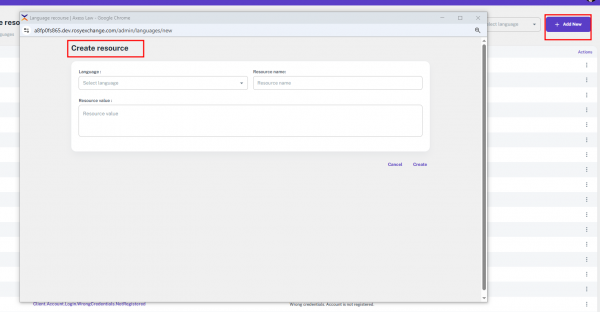
Step 4 – Change Language from the Header
- Click the profile icon in the top header.
- Use the language selector to switch between EN (English) and FR (French).
- The interface will update immediately for the current session.
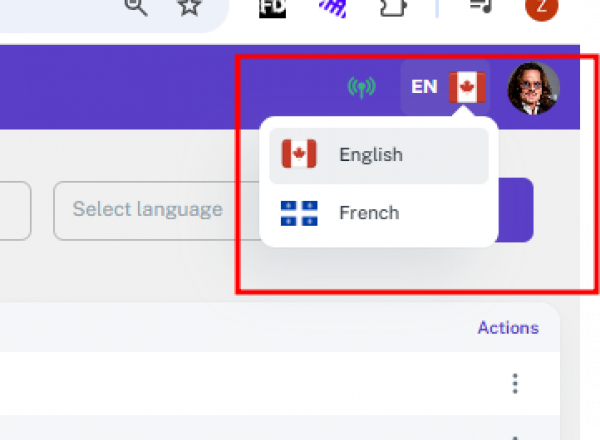
14.8.2 Functionality
The Language module ensures smooth bilingual support for English (EN) and French (FR) across the platform.
How It Helps:
- Instant Language Switching
- Users can change the interface language directly from the header without going to the Admin panel.
- Centralized Translation Management
- Admins can view, edit, and add translation keys and values for both languages from a single location.
- Improved Localization
- Consistent translation of UI text enhances the user experience for multilingual teams and clients.
14.9 Lawyer Checklist
The Lawyer Checklist section allows administrators to create and manage checklist items filtered by File Type and Province.
These checklist items ensure consistent legal reviews by automatically linking the relevant tasks to a file based on its province and file type.
14.9.1 Interface
Step 1 – Open the Lawyer Checklist Section
- From the top header menu, click the Admin tab.
- A left-side panel will appear.
- Select the Lawyer Checklist to open the page.
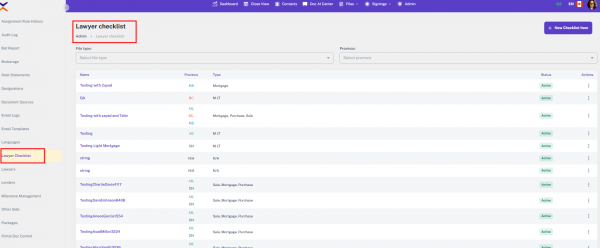
Step 2 – Filter Checklist Items
At the top of the page, use the dropdown filters to narrow results:
- File Type – Select a specific file type.
- Province – Select a province.

These filters help users narrow down and search relevant checklist items quickly.
Step 3 – Understand the Lawyer Checklist Table
The table displays the following columns:
- Name – The checklist item’s title.
- Province – The province(s) where the checklist applies.
- Type – The file type(s) linked to the checklist.
- Status – Active or Inactive.
- Actions – Edit button to update the checklist item.

Step 4 – Add a New Lawyer Checklist Item
- Click Add New Checklist Item to open the “Add Lawyer Checklist” form.
- Fill in:
- Lawyer Checklist Item – Enter the checklist name.
- File Types – Choose one or multiple file types.
- Provinces – Choose one or multiple provinces.
- Status – Mark as Active or leave Inactive.
- Click Add to save or Cancel to discard changes.
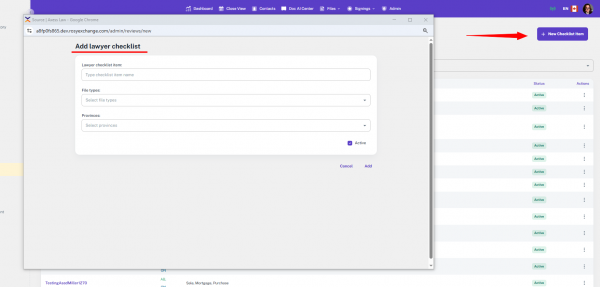
Step 5 – Edit an Existing Checklist Item
- In the Actions column, click Edit to open the “Update Lawyer Checklist” form.
- Modify the checklist name, file types, provinces, or status as needed.
- Save the changes or cancel the update.
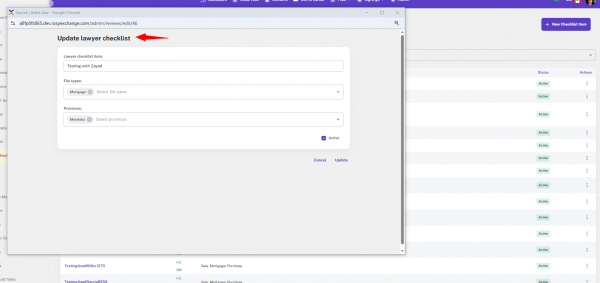
14.9.2 Functionality
The Lawyer Checklist feature ensures that relevant legal review items are automatically linked to new files based on the selected Province and File Type.
How It Works:
- Automatic Linking
- When creating a file, the system matches the chosen province and file type against the Lawyer Checklist database and attaches the applicable items to the file.
- In-File Visibility
- The linked checklist items appear in the Lawyer Checklist section of the File Details page.
- Ongoing Tracking
- Users such as Law Clerks or Lawyers can view, check, or uncheck items as the file progresses.
- Consistent Legal Processes
- Helps maintain standardized review procedures according to regional and file-type requirements.
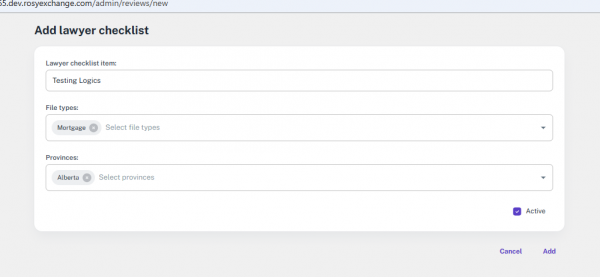

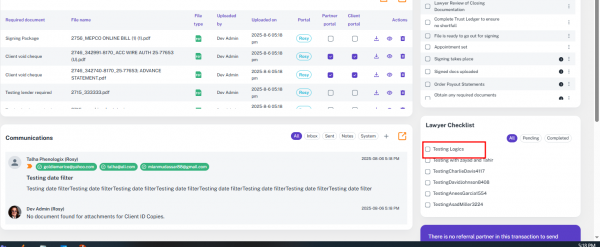
14.10 Lawyers
This guide explains how to add, edit, search, and delete lawyer records. Lawyers are stored in the system to facilitate easy reference in legal files, particularly when collaborating with external parties. Each lawyer's record contains personal and firm details to assist in communication and tracking.
14.10.1 Interface
Method 1 – Access the Lawyers Section
Use this method when you need to view, manage, or add information about lawyers.
Step 1 – Open the Admin Tab
- Click the Admin tab in the top navigation bar.
Step 2 – Select Lawyers
- A left-side menu will appear.
- Click Lawyers from the menu.
Step 3 – Lawyers Management Screen
- You will now see the Lawyers Management Screen, where you can search, add, edit, or delete lawyer records.
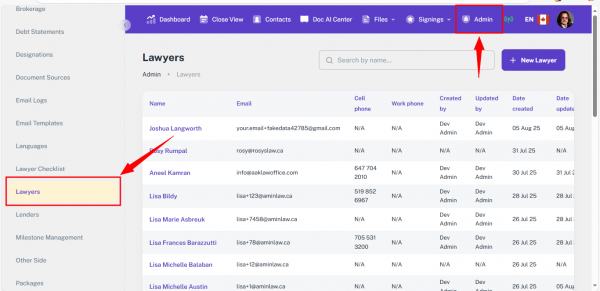
Method 2 – Search and Add a Lawyer
Step 1 – Search for a Lawyer
- Use the Search Bar at the top to find a lawyer by name.
Step 2 – Add a Lawyer
- Click the Add Lawyer button (next to the search bar) to create a new entry.
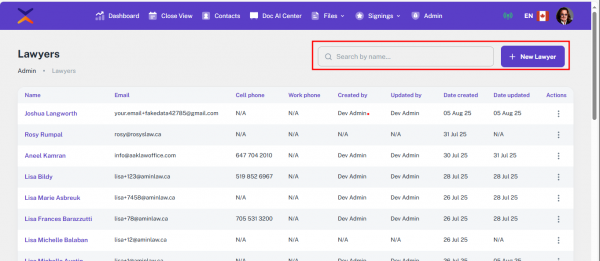
Method 3 – Understanding the Lawyers' Table
The table lists all lawyers and displays:
- Name
- Email
- Cell Phone
- Work Phone
- Created By
- Updated By
- Created Date
- Date Updated
- Action Button (three-dot menu)
Available Actions:
- Click the Name or the Action button to:
- Edit lawyer details
- Delete the lawyer record
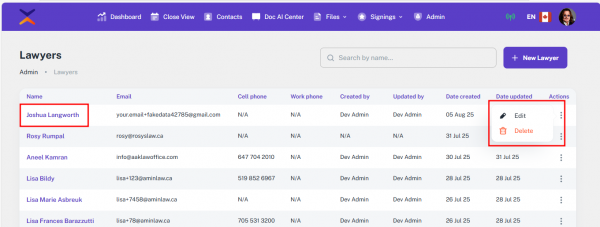
Method 4 – Add a New Lawyer
Step 1 – Open the Add Lawyer Form
- Click the Add Lawyer button.
- The Add Lawyer Form will appear, divided into two sections:
Card 1 – Personal & Contact Information
- First Name (Required)
- Middle Name (Optional)
- Last Name (Required)
- Email (Required)
- Work Phone
- EXT (Work)
- Cell Phone
- EXT (Cell)
- Address
- Street Name
- City
- Province (Searchable dropdown)
- Postal Code
- Country
- Fax Number
- Lawyer Comment (Optional)
Card 2 – Firm Details
- Firm Name
- Firm Address
- Firm Comment (Optional)
Form Action Buttons
- Add – Saves the lawyer record to the system.
- Cancel – Discards the changes and closes the form.
💡 Note: Only First Name, Last Name, and Email are required. All other fields are optional.
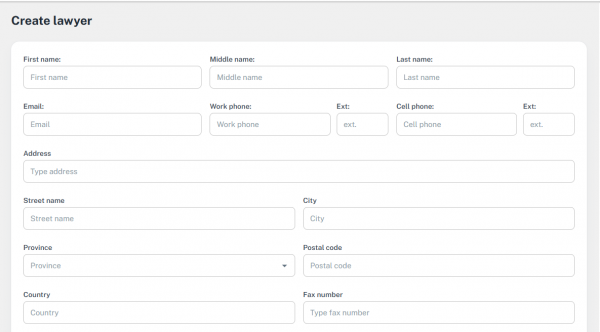
Method 5 – Edit or Delete a Lawyer
Step 1 – Select a Lawyer
- Click on the Lawyer's Name in the table or
- Click the Action button at the end of the row.
Step 2 – Edit or Delete
- Edit: Update the details using the same form as when adding a lawyer.
- Delete: Remove the lawyer record if no longer needed.
14.10.2 Functionality
This guide explains how to add and manage lawyers from the other party’s side (not your firm’s internal lawyers) in the File Section.
The option to add a lawyer depends on the Transaction Type you select for the file.
Method 1 – Adding a Lawyer When Creating or Editing a File
Step 1 – Select a Supported Transaction Type
- Create a new file or edit an existing one.
- In the Transaction Type dropdown, choose any of these:
- Purchase
- Sale
- LDR Rep
- Change of Ownership
- Discharge
- Reverse-M
- Once a supported type is selected, the Lawyer and Clerk fields will appear under the End/Other Side Client section.
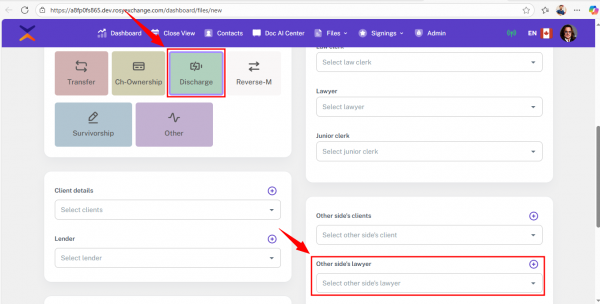
Step 2 – Select or Add a Lawyer
- Open the Lawyer dropdown to choose from existing lawyers.
- If the required lawyer is not listed, click the Add button to create a new one.
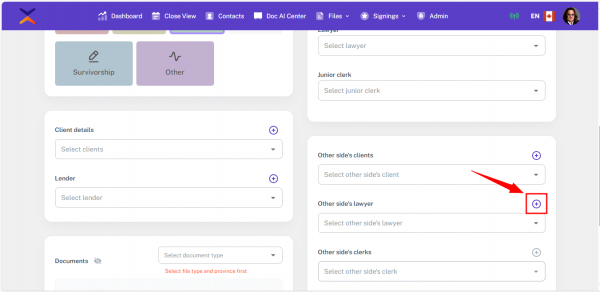
When adding a new lawyer this way:
- They will be automatically selected for the current file.
- They will also be saved under Admin → Lawyers for future use.
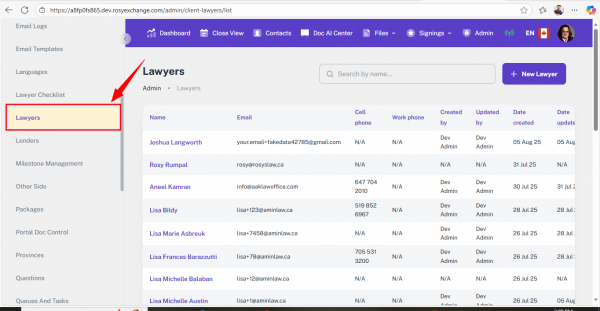
Step 3 – Confirm Lawyer in the File
- After saving the file, the selected lawyer will appear in the Other Side card of the file.
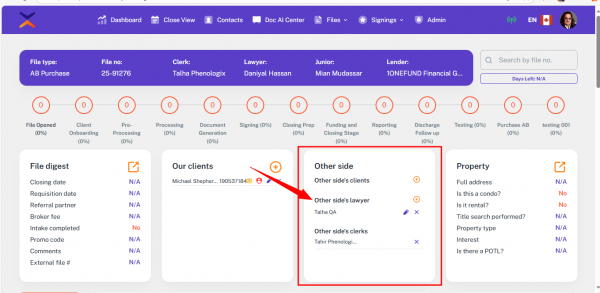
Note: If the file’s transaction type was something else and is later changed to one of the supported types, the option to add or update a lawyer will appear again.

Method 2 – Editing or Changing an Existing Lawyer
Step 1 – Open the File with the Linked Lawyer
- If a lawyer is already linked to the file, you can:
- Click the Edit icon to update their details, or
- Add a different lawyer if needed.
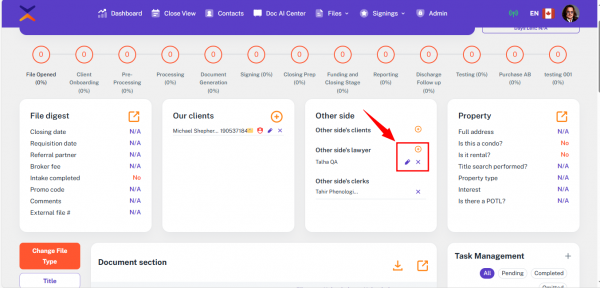
Step 2 – Save Changes
- Any newly added lawyer will also be stored in Admin → Lawyers for future selection.
Important Notes – External Party Lawyers
- This feature is only for adding lawyers from the opposite party’s side.
- These lawyers represent the other party in the transaction and are not part of your own firm.
14.12 Lenders
The Lenders module in the Admin Panel allows you to manage all lender-related records used throughout the platform. These records are referenced during file creation, document generation, communication, and other automated processes. This section supports detailed lender information, including contacts, discharge, and payout details.
14.12.1 Interface
Method 1 – Access the Lenders Section
Use this method to open the Lenders Management Page.
Step 1 – Open the Admin Tab
- Click the Admin tab in the top navigation bar.
Step 2 – Select Lenders
- From the left-side menu, click Lenders.
- You’ll be redirected to the Lenders Management Page.
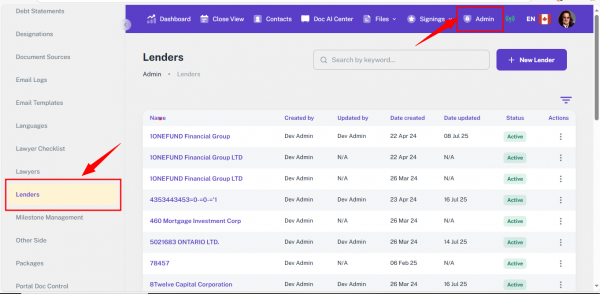
Method 2 – Search and Filter Lenders
Use this method to quickly locate specific lender records.
Step 1 – Search by Name
- Type the lender’s name in the Search bar.
Step 2 – Filter by Date
- Use Created Date (Start) and Created Date (End) filters to narrow down results.
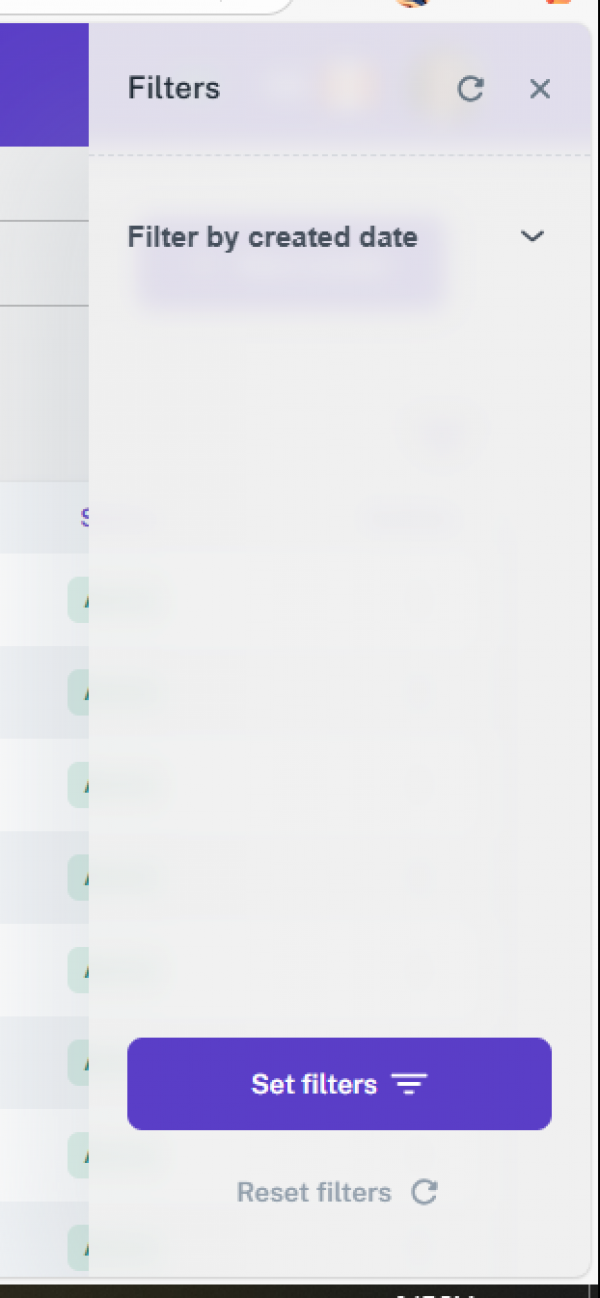
Method 3 – Add a New Lender
Use this method to create a lender record.
Step 1 – Open the Add Lender Form
- Click the Add Lender button near the search bar.
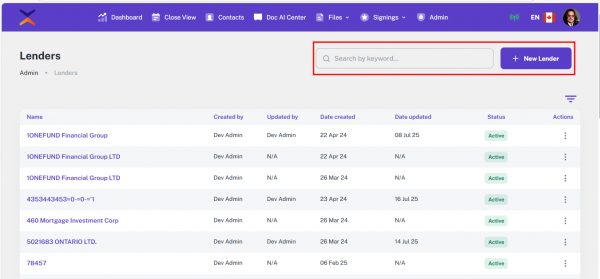
Step 2 – Fill in Lender Details
The form is divided into multiple sections (cards):
Personal Information
- Name (Required)
- Lender Type (Required)
- Institution Number, Email, Phone, EXT, Fax
- Full Address (Street No, Name, City, Province, Postal Code)
- Comments
- Active (Checkbox)
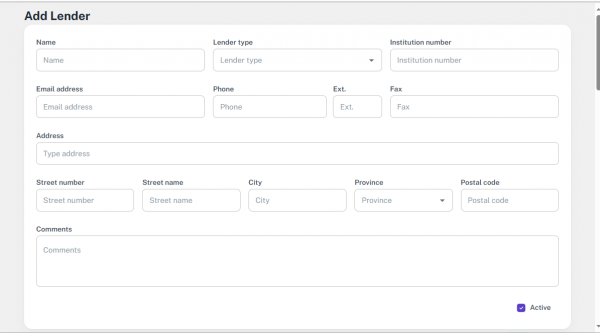
Escalation Contact
- Email, Phone, EXT, Fax
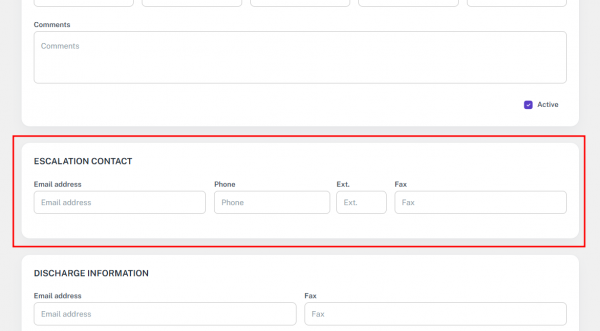
Discharge Information
- Email, Fax
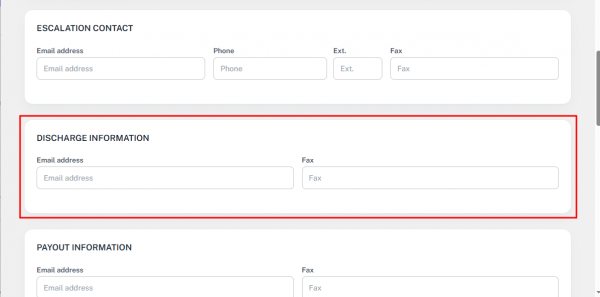
Payout Information
- Email, Fax, Payout Statement URL
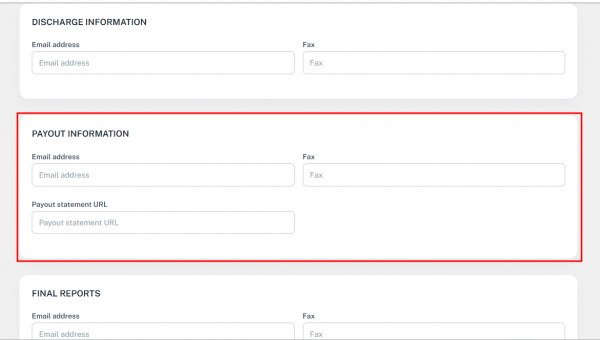
Final Report
- Email, Fax
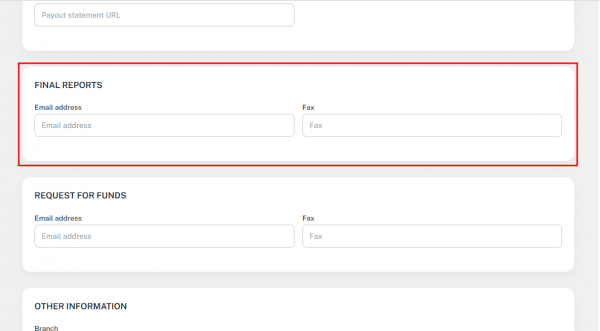
Required Funds
- Email, Fax
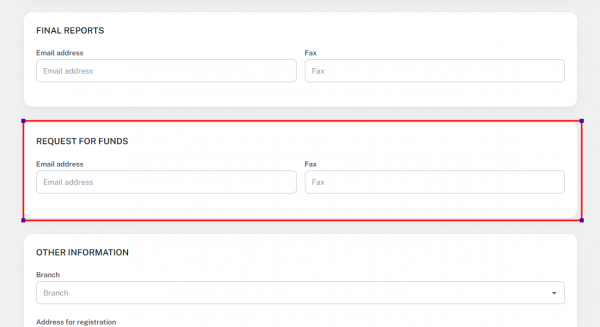
Other Information
- Branch (Dropdown)
- Address for Registration and Service (Street, City, Province, Postal Code)
- Signing Authority: Lawyer / Signing Agent / Both
- Virtual Document: Yes / No / Unknown
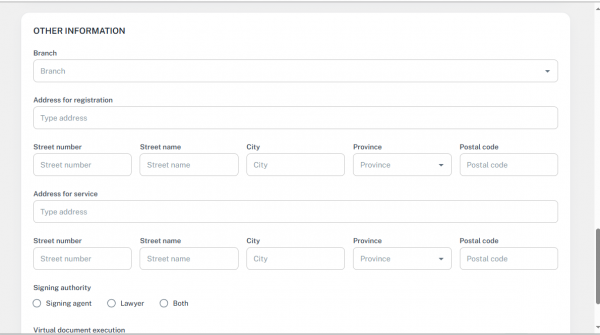
Step 3 – Save the Lender
- Click Create to save.
- Click Cancel to discard changes.
✅ Note: Only Name and Lender Type are required. All other fields are optional.
Method 4 – Edit an Existing Lender
Use this method to update lender details.
Step 1 – Open the Lender Record
- Click the lender Name in the table, OR
- Use the Action Button and select Edit.
Step 2 – Update the Details
- The same form used for creation will appear with existing data.
- Make the changes and click Update.
14.10.2 Functionality
This guide explains how the Lender selection works in the File Section for different transaction types, especially for LDR Rep files. In most cases, the Lender is displayed as “Lender,” but in LDR Rep transactions, it appears as “Client” while still being saved as a Lender in the backend.
Method 1 – Adding a Lender When Creating a File
Step 1 – Open the File Creation Form
- When creating a new file, locate the Lender dropdown.
- Use the dropdown to select an existing lender.
- If the lender you need is not listed, click the Add (+) button above the dropdown to create a new one.
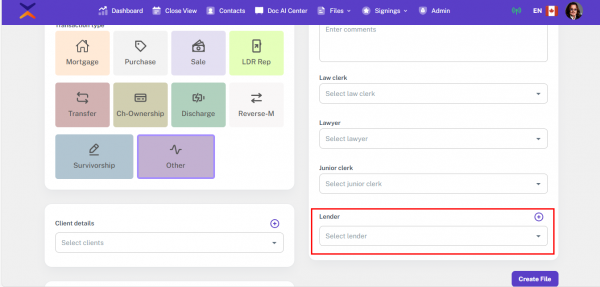
Step 2 – Label Display for Different Transactions
- For all Transaction Types except LDR Rep, this field appears as Lender.
- For LDR Rep, the label changes to Client in the UI but is still stored as a Lender in the backend.
Method 2 – Special Behavior for LDR Rep Transactions
Step 1 – Select LDR Rep as Transaction Type
- In the file creation form, set the Transaction Type to LDR Rep.
- The Lender field label will now show Client in the UI.